




Seeing the Invisible Rainbow
Imagine the light from a rainbow. It’s a beautiful spectrum from red to violet. But what if the rainbow kept going on either side, into colours our eyes can't perceive? That’s the reality of the electromagnetic spectrum. Just beyond the red light we can see
lies infrared, a type of radiation our skin might feel as heat but our eyes cannot detect. Every object with a temperature, from distant stars to interstellar dust clouds, emits infrared radiation. By building telescopes that can detect this invisible light, astronomers gain access to a treasure trove of information that would otherwise be lost. Telescopes like the James Webb Space Telescope (JWST) are specifically designed to capture these wavelengths, opening up a new window to the cosmos.
Piercing the Cosmic Veil
One of the biggest challenges in astronomy is cosmic dust. Huge clouds of gas and dust drift through space, acting like thick fog that blocks visible light. This is especially a problem when trying to observe stellar nurseries—the birthplaces of stars and planets—or the core of our own Milky Way galaxy. These regions are shrouded in dust, making them invisible to optical telescopes. However, infrared light has a longer wavelength than visible light, which allows it to pass through these dusty clouds without being scattered or absorbed. It’s the cosmic equivalent of using a thermal camera to see through smoke. This ability allows scientists to peer directly into the hearts of star-forming regions and witness the processes that lead to the creation of new worlds.
A Time Machine to the Early Universe
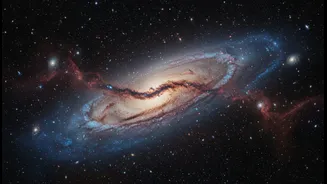
Infrared telescopes are not just for seeing through dust; they are also powerful time machines. The universe has been expanding since the Big Bang, and this expansion stretches the fabric of space itself. As light from the most ancient and distant galaxies travels across billions of light-years to reach us, its wavelength gets stretched out along the way. This phenomenon is called cosmological redshift. Light that was originally emitted as visible or even ultraviolet light from the first stars and galaxies has been stretched so much that by the time it arrives at our telescopes, it is in the infrared part of the spectrum. To see these first-generation galaxies and understand how the universe began, we must look for their faint, redshifted glow in infrared light.
Observing the Cool and the Faint
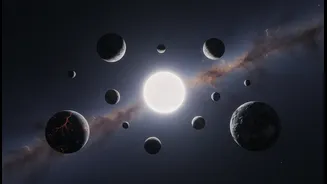
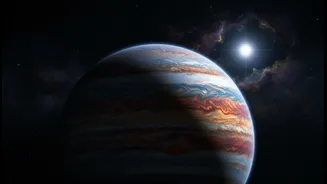
While very hot, massive stars shine brightly in visible light, many objects in the universe are much cooler and fainter. Objects like brown dwarfs (often called “failed stars”), exoplanets, and the dusty disks around stars where planets form are too cool to emit much visible light. However, they do radiate heat, which makes them glow in the infrared spectrum. This allows astronomers to detect and study objects that would otherwise be completely invisible. For example, when searching for planets around other stars, the blinding glare of the host star in visible light can make it impossible to see a much smaller, dimmer planet. In infrared, the star is less bright, and the planet's own heat signature becomes detectable, a technique that has revolutionized exoplanet research.
The Modern Eye on the Cosmos
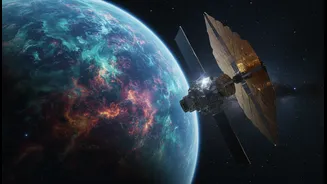
The James Webb Space Telescope (JWST) is the most powerful infrared observatory ever built, representing the culmination of decades of progress since early missions like the Infrared Astronomical Satellite (IRAS) and the Spitzer Space Telescope. Positioned far from Earth to stay incredibly cold and avoid interference, JWST’s highly sensitive instruments are designed to capture faint infrared signals from across the cosmos. Its capabilities allow it to study everything from the atmospheres of potentially habitable exoplanets to the formation of the very first galaxies. Discoveries made with infrared telescopes have fundamentally reshaped our understanding of how stars are born, how galaxies evolve, and the very origins of our universe.