





The Big Splash
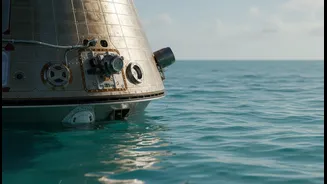
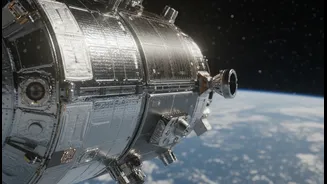
The return of the Orion spacecraft is a dramatic event. After flying more than a million kilometres, the capsule, carrying four astronauts, will re-enter Earth’s atmosphere at a mind-boggling speed of nearly 40,000 kilometres per hour. Its advanced heat
shield must protect it from temperatures reaching 2,760°C. A precise sequence of eleven parachutes then deploys, slowing the craft from hypersonic speeds to a gentle splash of about 32 km/h in the Pacific Ocean, off the coast of California. This spectacular landing is just the beginning of the spacecraft's journey back to the engineers.
First Responders of Space
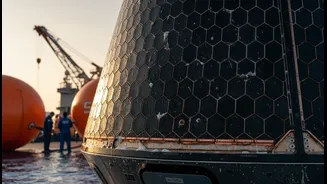
As soon as Orion hits the water, a highly trained team springs into action. A joint NASA and U.S. Department of Defense team, which has practiced for this moment for years, approaches the capsule in small boats. A special unit of Navy divers, including a medical team, are the first to make contact. Their job is to check the area for any hazards, attach an inflatable 'front porch' to the hatch for stability, and help the astronauts exit the capsule safely. This team is the first human contact the crew has after their long voyage in deep space.
From Ocean to Ship's Dock
Getting a multi-tonne spacecraft out of the ocean is a huge challenge. Once the crew is safely airlifted by helicopter to a nearby naval ship like the USS John P. Murtha for medical checks, the focus shifts to recovering the capsule itself. The divers attach a series of lines to Orion, and a powerful winch system on the recovery ship carefully pulls the spacecraft into a flooded area at the ship's waterline, known as the well deck. Once Orion is positioned over a specially designed cradle, the water is drained, securing the capsule for its journey to land. This entire process can take several hours and requires calm seas and perfect coordination.
The Journey Back to the Lab
After the recovery ship docks at a naval base in San Diego, the Orion spacecraft is carefully lifted by a crane onto a large transport platform. This begins its long road trip across the country back to NASA's Kennedy Space Center in Florida. Even before it leaves the ship, engineers begin their work. They remove some components like seats and video recorders for early analysis. The journey to Florida is slow and methodical, ensuring the precious cargo—and all the data it holds—arrives safely for a deep dive inspection.
A 'Health Check' for the Spacecraft
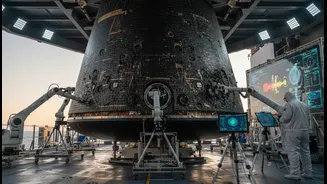
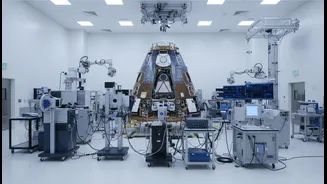
Back at Kennedy, the real work begins. The Orion capsule is taken to a special facility where engineers will spend months examining every inch of it. They look at the performance of its heat shield, which is a key focus after some unexpected erosion was seen on the uncrewed Artemis I mission. They will download all the flight data and inspect every system, from life support and navigation to the simple tiles on its shell. Any signs of wear and tear, micrometeoroid impacts, or unexpected behaviour are documented. This detailed analysis is like a full-body health check-up for the spacecraft.
Why Do All These Checks Matter?
These post-flight checks are not just about this one mission. They are essential for ensuring the safety of all future Artemis missions. The data gathered helps engineers understand how the spacecraft holds up to the harsh environment of deep space and the intense heat of re-entry. For Artemis II, some components from the Artemis I flight were reused. This process will scale up, with future missions reusing even more parts to make space travel more sustainable and affordable. By understanding every detail of Orion's performance, NASA can make improvements and certify the vehicle is safe to take the next astronauts to land on the Moon on the Artemis III mission and, eventually, journey to Mars.