




How to Read an Alien Atmosphere
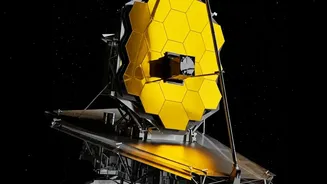
The magic behind these discoveries is a technique called transmission spectroscopy. When an exoplanet passes in front of its host star from our perspective, a tiny fraction of the starlight filters through the planet's atmosphere. The JWST, with its incredible
sensitivity to infrared light, captures this light. Different molecules in the atmosphere absorb specific wavelengths (or colors) of this infrared light, leaving a unique chemical fingerprint. By analyzing which colors are missing from the star's light, scientists can deduce precisely what gases are present—like water, methane, or carbon dioxide. It’s like using a cosmic prism to reveal the ingredients of a world we can never physically visit.
The Search for Biosignatures
This atmospheric data is more than just a chemical inventory; it's a critical tool in the search for life. Scientists are looking for 'biosignatures'—gases that, on Earth, are overwhelmingly produced by living organisms. One key target is the combination of methane and carbon dioxide. While either gas can exist on its own due to geology, finding them together in a state of disequilibrium could suggest a constantly replenishing source, like a biosphere. For instance, on the candidate 'Hycean' (hot and ocean-covered) world K2-18b, Webb has detected not only methane and carbon dioxide but also a hint of dimethyl sulfide, a compound that on Earth is only produced by life, primarily marine phytoplankton. While this isn't definitive proof, it's a tantalizing clue that moves a planet into the 'potentially habitable' category.
A Universe of Unexpected Worlds
The data from Webb isn't just about finding Earth 2.0. It’s revealing a stunning diversity of planets that challenge our models of how solar systems form. Webb has studied a temperate Saturn-sized planet with methane in its atmosphere, a 'lava planet' where rock is molten and the atmosphere may be shaped by volcanic outgassing, and even a world that survived its star's death, leaving it with a bizarre atmosphere rich in molecular carbon. These discoveries show that nature is far more creative than we imagined. Each unusual world helps scientists refine their theories on planetary evolution, explaining why some planets become gas giants, some become rocky worlds, and others become something else entirely.
From Detection to Characterization
Ultimately, the infrared data from JWST marks a fundamental shift in exoplanet science. We are moving beyond the era of simply detecting planets to an era of characterization. Instead of just knowing a planet's size and orbit, we can now ask deeper questions about its climate, weather, and chemistry. This doesn't mean finding life will be easy. The data is complex, and sometimes initial signs of an atmosphere, like water vapor on planet GJ 486 b, can turn out to be interference from the star itself upon closer inspection. This complexity, however, is part of the process. It's teaching astronomers how to distinguish a planet's signal from its star's and how to build a more complete picture of these distant systems.