
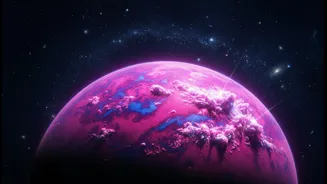


Meet Our New Cosmic Neighbour
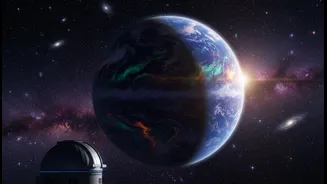
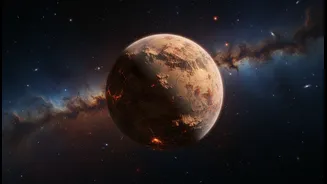
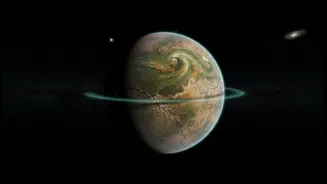
Scientists have confirmed the existence of a ‘super-Earth’ exoplanet named GJ 3378b, an exciting world orbiting a star just 25 light-years from us in the constellation Camelopardalis. While first designated as a potential planet in 2024, revised analysis
has painted a much more intriguing picture. Researchers now estimate its mass at about 2.3 times that of Earth, placing it firmly in the ‘super-Earth’ category—a rocky world larger than our own but smaller than Neptune. Further observations also refined its orbit, revealing that it circles its star every 21 days. This new information shifts the planet directly into its star’s habitable zone, sparking intense scientific interest.
The Allure of Red Dwarf Stars
GJ 3378b orbits a red dwarf, the most common type of star in our Milky Way galaxy, accounting for roughly 75% of all stars. These stars are much smaller, cooler, and dimmer than our Sun. Because they are less luminous, their ‘habitable zone’—the region where temperatures could allow liquid water to exist on a planet’s surface—is much closer to the star. This proximity makes planets easier for astronomers to detect using methods like observing the star's 'wobble' (radial velocity) caused by a planet's gravitational pull, which is how GJ 3378b was studied. Their sheer abundance means that if life can thrive around red dwarfs, the universe could be teeming with habitable worlds.
A World in the ‘Goldilocks Zone’
The confirmation that GJ 3378b lies within its star's habitable zone is a major development. It receives about 90% of the radiation from its star that Earth gets from the Sun, placing it in a temperate 'Goldilocks' region—not too hot and not too cold. In theory, this is the sweet spot where surface temperatures could permit liquid water, a key ingredient for life as we know it. However, being in the right location is only the first step. A planet’s actual surface conditions depend almost entirely on another, much more elusive factor: its atmosphere.
The Great Atmospheric Mystery
The biggest question hanging over GJ 3378b is whether it has an atmosphere at all. An atmosphere is a make-or-break feature for habitability. It provides the necessary surface pressure to maintain liquid water, shields the surface from harmful stellar radiation, and traps heat to regulate the planet's temperature. Without an atmosphere, GJ 3378b would be an airless, cratered rock. With a thin, Earth-like atmosphere, it could be a temperate world. But with a thick, dense atmosphere, it could become a 'tidal Venus,' a superheated greenhouse planet inhospitable to life. Until we can find out, its true nature remains a mystery.
Perils of a Red Dwarf Host
Even with an atmosphere, life around a red dwarf faces serious challenges. Many red dwarfs, especially when young, are extremely active, unleashing powerful stellar flares of high-energy radiation. These flares can be strong enough to strip a nearby planet of its atmosphere over time and blast its surface with deadly radiation. Another significant issue is tidal locking. Because planets in a red dwarf’s habitable zone are so close to their star, they often become tidally locked, meaning one side perpetually faces the star while the other is in permanent darkness. This would create a world of extreme temperatures, with a scorching hot dayside and a frozen nightside, making habitability complicated.
What Happens Next?
GJ 3378b is now a prime target for future study. Scientists are eager to use the next generation of powerful observatories, particularly the James Webb Space Telescope (JWST), to search for signs of an atmosphere. By using a technique called transmission spectroscopy, astronomers can analyze the starlight that passes through a planet's atmosphere during a transit. Different gases absorb specific wavelengths of light, leaving behind a chemical fingerprint that JWST can detect. Finding and analyzing these fingerprints would be the first real step in determining whether this nearby super-Earth is a barren rock or a world of possibility.