
A New Eye on the Cosmos
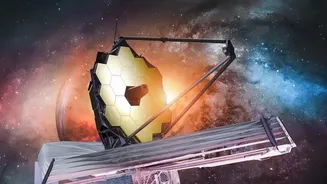
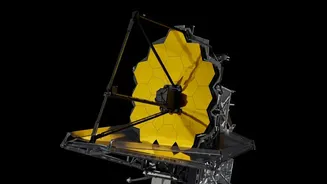
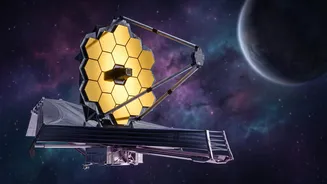
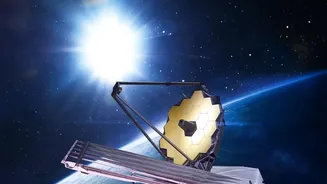
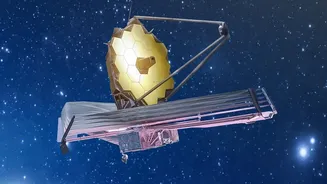
Launched on Christmas Day 2021, the James Webb Space Telescope is the most powerful and complex space observatory ever built. With its iconic 6.5-metre, gold-coated mirror, it is designed to see the universe in infrared light. This is a crucial capability
because infrared is invisible to the human eye but holds the secrets to the early universe, star formation, and the chemical makeup of planets far beyond our solar system. Unlike its predecessor, the Hubble Space Telescope, which observed primarily in visible and ultraviolet light, JWST’s specialization in infrared allows it to pierce through cosmic dust clouds and capture the faint heat signatures of distant objects. This makes it uniquely suited to a technique called transmission spectroscopy, the primary tool scientists are now using to hunt for water on exoplanets.
The Science of Starlight
So, how does spectroscopy let us see the unseeable? Imagine an exoplanet passing in front of its host star, an event known as a 'transit.' As the starlight filters through the planet's atmosphere, molecules within that atmosphere absorb specific wavelengths, or colours, of light. Every molecule, from methane to carbon dioxide, has a unique absorption 'fingerprint.' Water is no exception. JWST's highly sensitive instruments, like the Near-Infrared Imager and Slitless Spectrograph (NIRISS), act like cosmic prisms. They take the starlight that has passed through the planet's atmosphere and spread it out into a detailed spectrum—a rainbow of thousands of infrared colours. By looking for the tell-tale dips in this spectrum, scientists can identify the unambiguous signature of water vapour, even from hundreds or thousands of light-years away.
Water, Haze, and Clouds
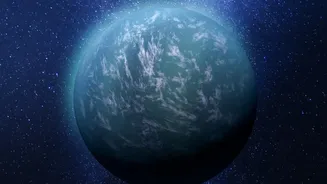
One of JWST's first major successes in this area was its observation of WASP-96 b, a 'hot Jupiter' exoplanet located about 1,150 light-years from Earth. While Hubble had previously detected water in exoplanet atmospheres, Webb’s observation provided the most detailed spectrum of its kind to date. The data not only confirmed the presence of water with stunning clarity but also revealed evidence of clouds and haze, which earlier studies had not detected. This was a monumental leap forward. More recently, in findings from early 2026, the telescope detected undeniable water vapor signatures on a nearby super-Earth, shifting the search for life from pure theory to active investigation. The telescope can even distinguish between different types of water, such as the detection of 'semi-heavy water' on the hot gas giant WASP-39 b, which provides clues about how and where a planet formed. These discoveries showcase JWST's power to not just find water, but to begin building a complete chemical and physical profile of alien worlds.
The Blueprint for Habitability
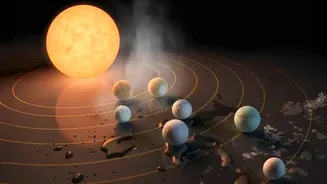
Finding water vapor doesn't automatically mean finding life. Many of the planets where water has been detected, like the scorching hot WASP-96 b, are gas giants with temperatures over 500°C and are not considered habitable. However, these initial findings are crucial proof of concept. They demonstrate that JWST possesses the precision needed to analyze the atmospheres of smaller, rocky, and more temperate worlds, like those in the TRAPPIST-1 system. Furthermore, in late 2025, JWST found strong evidence of an atmosphere on a molten rocky exoplanet, TOI-561 b, challenging theories that planets so close to their stars couldn't retain one. By studying where and how water exists—whether as vapor, ice, or part of a planet’s formation in a protoplanetary disk—scientists can piece together the story of planetary evolution. Each detection is a step towards understanding the conditions that could make a planet a viable home for life, refining the search for a true Earth-twin.