




A Different Kind of Ring
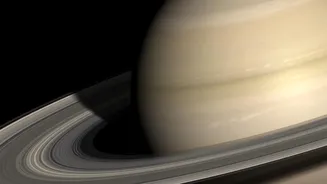
Unlike Saturn’s bright rings, which are full of highly reflective ice, Jupiter's are made of tiny, dark dust particles, some finer than cigarette smoke. This composition makes them incredibly difficult to see unless they are backlit by the Sun. For decades
after their discovery, the origin of this ghostly system was a puzzle. While Saturn’s rings might be ancient, perhaps remnants from the solar system's formation, Jupiter's rings are a far more dynamic and violent creation, constantly being resupplied by an unlikely source: its own tiny moons.
The Unlikely Architects
The culprits behind Jupiter's rings are four of its small, inner moons: Metis, Adrastea, Amalthea, and Thebe. These are not grand, spherical worlds, but small, potato-shaped rocks. Amalthea, the largest of the group, is only about 170 kilometres across, while Adrastea is a mere 16 kilometres in diameter. Lacking atmospheres, these moons are completely exposed to the harsh environment of space and are constantly pelted by a stream of micrometeoroids—tiny fragments of comets and asteroids.
Cosmic Sandblasting in Action
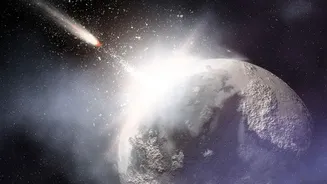
The creation of the rings is a process of cosmic 'sandblasting'. Interplanetary meteoroids, accelerated to incredible speeds by Jupiter's immense gravity, slam into these small moons. The impactor burrows into the moon, vaporises, and then explodes, blasting dust and debris from the moon's surface. Because these moons are so small, their gravitational pull is incredibly weak. This allows the ejected dust to easily escape into orbit around Jupiter instead of falling back onto the moon's surface. Think of it like banging two dusty chalk erasers together; a cloud of particles is released, and in this case, that cloud gets captured by the planet.
A Structure Built from Dust
This constant supply of dust organises itself into a distinct structure. The dust ejected from Metis and Adrastea forms the relatively bright 'Main Ring'. Outside of this are the two 'Gossamer Rings', which are much fainter and wider. These are supplied by dust kicked off Amalthea and Thebe. There is also an innermost, doughnut-shaped 'Halo Ring', believed to be formed by dust particles from the main ring that get pulled inward and sculpted by Jupiter's powerful magnetic field. The entire system is in a delicate balance; as dust particles spiral down into Jupiter, new dust from the moons replenishes the rings, meaning they are a constantly regenerating feature.