

The Smokescreen of a Hostile World
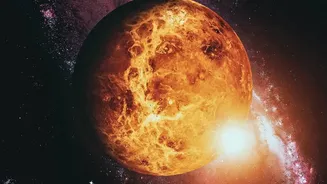
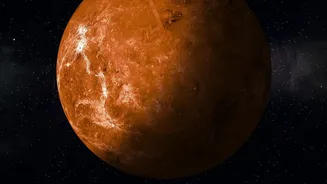
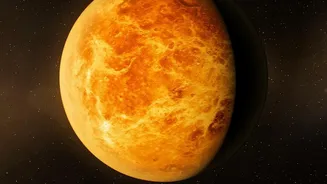
Venus presents a fascinating puzzle for planetary scientists. It’s similar to Earth in size and mass, yet its surface is a hellscape with temperatures hot enough to melt lead and an atmospheric pressure 90 times that of our own. This dense atmosphere,
rich in carbon dioxide and cloaked in sulfuric acid clouds, has made studying its surface incredibly difficult. However, scientists believe that massive, planet-altering volcanism played a key role in turning Venus into the inferno it is today. Evidence from past missions has shown a surface dominated by volcanic features, suggesting a violent geological history. The big question that ISRO’s Shukrayaan mission aims to answer is not just if volcanoes erupted, but when, how often, and whether they are still active today.
The Telltale Gas in the Air
The key to unlocking Venus's volcanic past lies in its atmosphere. Volcanoes on Earth release massive amounts of gases, and one of the most significant is sulfur dioxide (SO2). Scientists believe the same is true for Venus. Here’s the crucial part: when SO2 gets high into the Venusian upper atmosphere, it’s quickly broken down by sunlight. This means that any SO2 detected high above the clouds must have been put there very recently. A sudden spike in SO2 could be a “smoking gun,” indicating that a volcano has erupted somewhere below, punching a plume of gas through the dense cloud layers. Previous missions, like the European Space Agency's Venus Express, have observed dramatic fluctuations in SO2 levels, strengthening the case for active or recent volcanism.
ISRO’s Atmospheric Detective: VIRAL
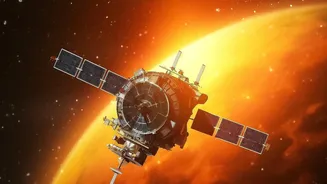
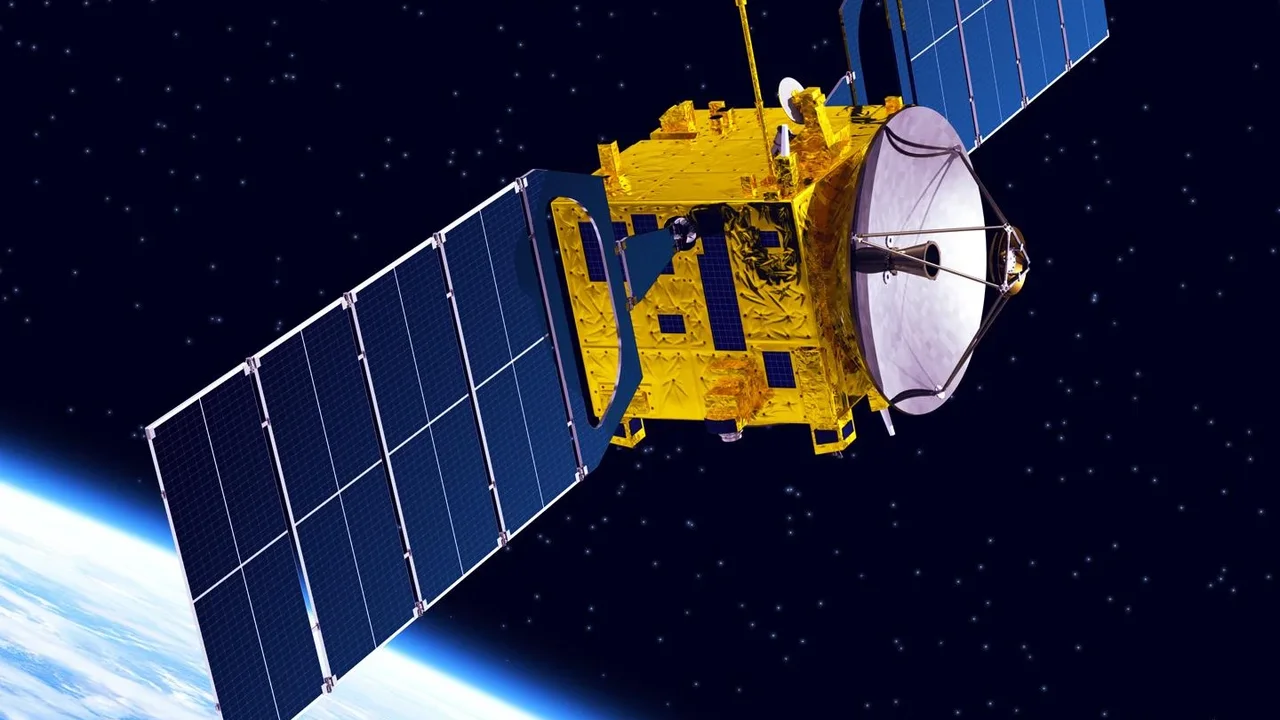
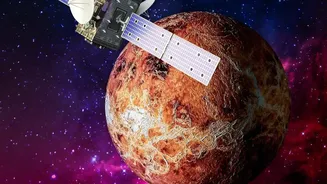
To hunt for these chemical clues, ISRO’s Shukrayaan orbiter will be equipped with a suite of sophisticated instruments. A key payload for this task is the Venus Infrared Atmospheric Gases Linker (VIRAL), an instrument developed in collaboration with Russian and French space agencies. VIRAL is a high-resolution spectrometer designed to analyse the composition of Venus's atmosphere with incredible precision. It will use a technique called solar occultation. As the spacecraft orbits Venus, it will watch the sun rise and set through the planet's atmosphere. By measuring how sunlight is absorbed by the different gases at various altitudes, VIRAL can create a detailed vertical profile of the atmosphere’s chemical makeup, including trace gases like sulfur dioxide. This will allow scientists to spot telltale concentrations of volcanic gases and understand how they are distributed and transported within the atmosphere.
Peering Through the Clouds with Radar
Analysing atmospheric gases provides one half of the story. To build a complete model of Venus's volcanic history, scientists need to see the volcanoes themselves. This is where another of Shukrayaan's primary instruments comes in: a high-resolution Synthetic Aperture Radar (SAR). Venus's thick clouds make it impossible to take traditional optical photos of the surface from orbit. SAR, however, works by sending down radar signals that can penetrate the cloud cover, bounce off the surface, and return to the orbiter. By analysing these echoes, scientists can create detailed, three-dimensional maps of the terrain below. ISRO’s SAR is designed to be powerful enough to map the surface in high resolution, allowing it to identify ancient lava flows, volcanic cones, and other geological features that tell the story of past eruptions.
Building the Complete Picture
The true strength of the Shukrayaan mission lies in combining these two approaches. The atmospheric data from instruments like VIRAL will provide a dynamic, near-real-time look at potential volcanic activity by tracking gases. Simultaneously, the SAR will provide the static, long-term geological context by mapping the physical evidence of volcanism on the ground. For example, if VIRAL detects a sudden plume of sulfur dioxide in a specific region, scientists can then direct the SAR to scan that same area for signs of a fresh lava flow or surface changes. By correlating atmospheric events with surface features, ISRO can build robust volcanic history models. This will help us understand not only Venus's evolution but also the powerful forces that can shape rocky, Earth-sized planets across the galaxy.