





Beyond the Planets
When we talk about the 'edge' of the solar system, we're primarily referring to the Kuiper Belt, a vast, disc-shaped region beyond the orbit of Neptune. It's a cosmic junkyard of icy bodies left over from the formation of the solar system, populated by
hundreds of thousands of objects, including famous dwarf planets like Pluto, Eris, and Makemake. For a long time, these were considered inert, frozen relics. But a steady stream of surprising data, most notably from NASA's New Horizons mission, has painted a much more dynamic picture, suggesting that these frigid worlds may be geologically active.
The Surprise of Subsurface Oceans
The 'liquid activity' that has scientists so excited isn't a collection of surface lakes or rivers. Instead, evidence points toward vast subsurface oceans of liquid water hidden beneath thick shells of ice. The idea seems counterintuitive; how could water stay liquid in a place where surface temperatures plummet hundreds of degrees below zero? The answer lies deep inside these worlds. Heat generated by the slow decay of radioactive elements in their rocky cores could be substantial enough to melt the bottom layers of the overlying ice, creating and maintaining an ocean. This internal heat gets trapped by the thick, insulating crust of ice, keeping the water from freezing solid for potentially billions of years.
Clues on the Frozen Surface
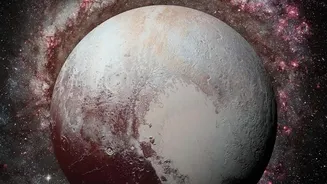
Scientists can't drill through hundreds of kilometres of ice, so they look for clues on the surface. One of the most compelling signs is cryovolcanism, or ice volcanoes. Instead of spewing molten rock, these volcanoes erupt a slushy mix of water, ammonia, and methane from the ocean below. On Pluto, the New Horizons spacecraft discovered enormous domes and rises with hummocky flanks that don't look like anything else in the solar system. Researchers believe these massive features were created by multiple cryovolcanic eruptions that resurfaced the region. Other clues include strange geological faults and the unexpected presence of compounds like ammonia, which acts as a natural antifreeze, further bolstering the case for a liquid interior.
Redefining the Search for Life
This is the real reason scientists care so deeply. On Earth, wherever we find liquid water, we find life. For decades, the search for extraterrestrial life has focused on the 'habitable zone' around a star—the narrow band where a planet is just the right temperature for surface water. The discovery of potential oceans on Pluto and other Kuiper Belt Objects shatters that concept. It suggests that habitable environments could exist far from a star's warmth, powered by internal heat instead. These subsurface oceans would be shielded from harsh space radiation by the ice above, providing a stable environment. While we haven't found life, we've found the primary ingredient it needs in the most unexpected of places.
A New Frontier of Habitability
The implications are profound. If a small, distant world like Pluto can hold onto a liquid water ocean, then many other large objects in the Kuiper Belt could as well. This dramatically expands the number of potentially habitable worlds within our own solar system. Suddenly, the search for life isn't just about Mars or the moons of Jupiter and Saturn. It now includes a whole new class of celestial bodies at the coldest, most distant frontier. These icy worlds are no longer just time capsules from the solar system's birth; they are active, evolving places that represent a new and exciting front in our quest to understand where life can arise.