


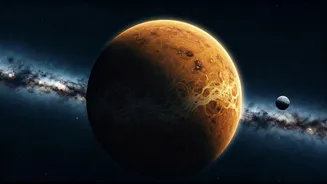


A Day Longer Than a Year
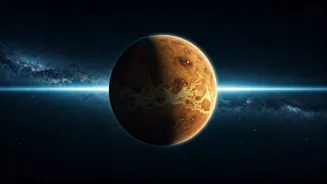
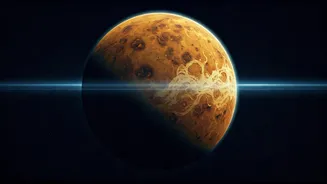
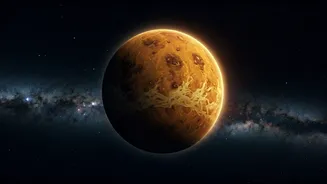
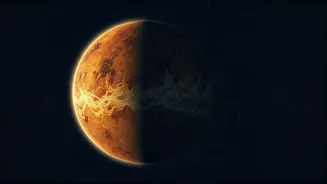
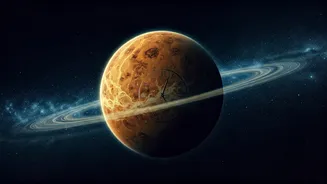
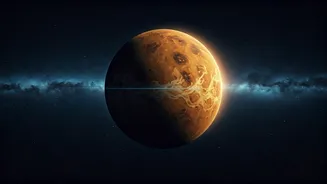
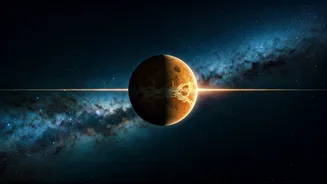
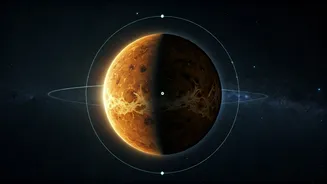
Let’s get the mind-bending numbers out of the way first. It takes Venus about 225 Earth days to complete one orbit around the Sun—that’s its year. But it takes a staggering 243 Earth days for it to complete just one rotation on its axis. This means that if
you could stand on the surface of Venus, a single day would last longer than an entire year. To make things even stranger, Venus spins 'backwards'. While Earth and most other planets in our solar system rotate from west to east, Venus performs a retrograde rotation, spinning from east to west. For a hypothetical Venusian, the Sun would rise in the west and set in the east. This combination of an incredibly slow and backward spin makes Venus a true outlier in our celestial neighbourhood, a puzzle that astronomers have been trying to solve for decades.
Earth's Twisted Sister Planet
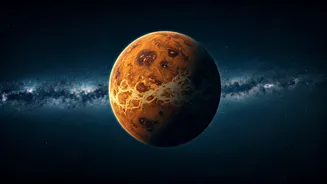
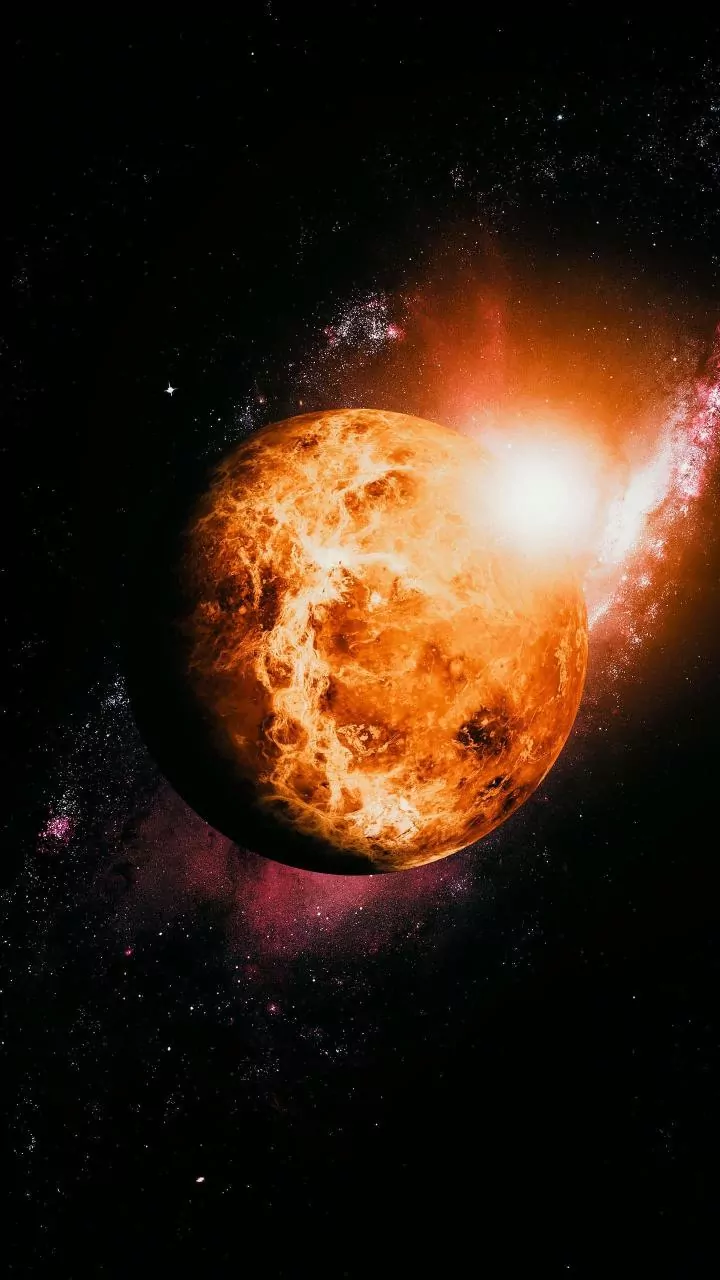
The obsession with Venus’s rotation isn’t just about a planetary quirk; it's about understanding why Earth’s twin went so wrong. Venus and Earth are often called sister planets because they are strikingly similar in size, mass, and composition. They formed in the same part of the solar system and are made of similar rocky materials. Yet, they couldn’t be more different today. Earth is a temperate world teeming with life, while Venus is a toxic inferno. Its surface temperature is a blistering 465°C, hot enough to melt lead, and its atmosphere is a crushing blanket of carbon dioxide and sulphuric acid clouds. Scientists believe that understanding Venus's bizarre rotation is a key piece in the puzzle of its runaway greenhouse effect. How did two such similar worlds end up on such dramatically different evolutionary paths? The answer might be hidden in its spin.
The Great Cosmic 'Why?'
So, why is Venus so slow and backward? There isn’t one simple answer, but scientists have a few leading theories. One popular idea is that early in its history, Venus was struck by a massive planet-sized object. Such a cataclysmic impact could have been powerful enough to not just halt its original spin but reverse it entirely, leaving it with the slow, retrograde motion we see today. Another compelling theory involves Venus’s incredibly dense atmosphere. At 92 times the pressure of Earth’s, this thick blanket of gas could be creating so much friction on the planet’s surface that it acts as a powerful brake, slowing its rotation over billions of years. A third possibility involves a complex gravitational dance. Some models suggest that a combination of the Sun’s powerful gravitational pull and tidal forces from its own thick atmosphere could have locked the planet into this strange, slow rotational state. The truth might be a combination of all these factors.
New Clues From Precise Measurements
The obsession has been supercharged by recent findings. For years, estimates of Venus’s day length varied by several minutes. But a landmark study published in 2021 provided the most precise measurement ever. A team of scientists from UCLA spent 15 years bouncing radar signals off Venus's surface from Earth. By analysing how the radio waves echoed back, they were able to calculate the planet's exact rotational speed, the tilt of its axis, and even the size of its core. They determined the Venusian day is precisely 243.0226 Earth days long and that it wobbles slightly on its axis. These precise numbers are not just trivia; they are crucial data points for computer models trying to simulate Venus's past and future. Knowing the exact spin and wobble helps scientists understand how mass is distributed inside the planet, providing clues about whether its core is liquid or solid.
Why This Bizarre Spin Matters
Ultimately, the fascination with Venus’s spin is about understanding habitability. The length of a planet's day has a profound impact on its climate. A slow rotation like Venus's means the sun-facing side bakes for months while the night side cools, creating extreme temperature differences that drive powerful winds. By understanding the link between Venus’s rotation and its hellish climate, scientists can better predict what makes a planet outside our solar system—an exoplanet—potentially habitable. This research helps us refine our search for another Earth. It’s also vital for future missions, including India's planned Shukrayaan-1 orbiter. To land a probe or even just orbit a planet safely, you need to know exactly how it’s spinning. Venus’s slow, strange day is not just a curiosity; it's a fundamental data point in our quest to understand our place in the cosmos.