

A New Window on Cosmic Dawn
For astronomers, looking at distant objects is the same as looking back in time. Light from the most remote galaxies has travelled for over 13 billion years to reach us, offering a snapshot of the universe when it was just a fraction of its current age.
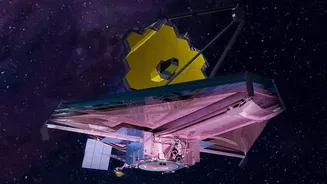
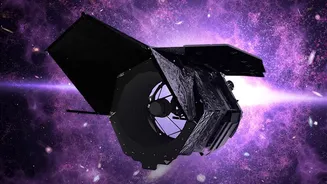
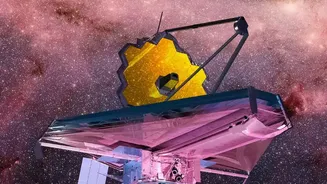
The James Webb Space Telescope (JWST) was specifically designed to capture this faint, ancient light. Its powerful infrared instruments can pierce through cosmic dust and detect signals that have been stretched over billions of years of cosmic expansion, a phenomenon known as redshift. Recent releases of data from large-scale JWST surveys have provided an unprecedented sample size, moving from studying a few early galaxies to statistically analysing hundreds at once. This leap in quantity and quality is giving us a much sharper picture of the era known as the Cosmic Dawn, the period just a few hundred million years after the Big Bang when the first stars and galaxies lit up the universe.
More Than Just Blurry Smudges
Before JWST, even our most powerful observatories like the Hubble Space Telescope saw the earliest galaxies as little more than faint, blurry red dots. It was difficult to tell if they were chaotic jumbles of stars or something more organised. The latest images have changed that entirely. Thanks to Webb’s superior resolution and sensitivity, astronomers can now resolve details within these ancient systems that were previously invisible. What used to look like a single, indistinct structure now separates into multiple components. Scientists are seeing evidence of complex structures, like rotating discs and massive clumps of star formation, far earlier than models had predicted. The new data is so precise that it allows astronomers to map the distribution of galaxies with much greater accuracy, sharpening our view of the vast, filament-like structure of the cosmic web that connects galaxies across the universe.
A Surprisingly Mature Universe
One of the biggest surprises from these new, sharper images is how mature some of these infant galaxies appear. Current theories of cosmology suggest that the first galaxies should have been small, messy, and still in the process of assembling. They were expected to be chaotic systems, slowly pulling in gas to fuel the first generations of stars. However, Webb is finding galaxies that are unexpectedly bright, massive, and structurally complex. Some show evidence of significant amounts of dust and heavier elements—the byproducts of previous generations of stars. This suggests that star formation began very early and was incredibly efficient, happening faster and more robustly than our models accounted for. In essence, the universe appears to have been in a hurry, building complex galaxies much more quickly than we ever thought possible.
Rewriting the First Chapters
These findings are forcing scientists to rethink the first chapters of cosmic history. The presence of well-formed structures and complex chemistry so early on poses a fascinating puzzle. How did these galaxies grow so big, so fast? Some studies suggest that early galaxies were incredibly effective at pulling in huge reservoirs of pristine hydrogen gas from their surroundings, providing the raw fuel for rapid star birth. Others are investigating whether the very first generation of stars—thought to be much more massive and brilliant than stars today—played a different role than anticipated. It's not that the Big Bang theory is wrong. Rather, the evidence suggests that the processes that governed galaxy formation in the early universe were more efficient and dynamic than our current frameworks can fully explain. The real universe is proving to be more complex than the models predicted.
Why Looking Back Matters
Understanding how the first galaxies formed is fundamental to understanding our own cosmic origins. The stars, planets, and even the elements in our bodies are all products of a chain of events that began in these first stellar nurseries. By studying the Cosmic Dawn, we are tracing the story back to its beginning. These sharper images not only provide answers but also raise new, more specific questions for astronomers to investigate. They offer new windows into studying how galaxies assemble and grow, linking the primordial matter from the Big Bang to the rich tapestry of galaxies we see today. Every new image from JWST provides another piece of the puzzle, helping us refine the story of how everything came to be.