




A Star Divided
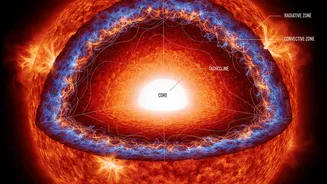
To understand the tachocline, you first need to know that the Sun is not a solid object. It's a massive sphere of superheated gas called plasma, structured in distinct layers. At the centre is the core, where nuclear fusion generates immense energy. This
energy travels outward through the vast radiative zone, a region so dense that it takes photons hundreds of thousands of years to pass through. The outermost 30% of the Sun's interior is the convection zone, a turbulent region where hot plasma rises, cools, and sinks in a constant boiling motion, much like a pot of water on a stove. Between the calm radiative zone and the churning convection zone sits the tachocline, an incredibly thin but crucial boundary layer.
Two Speeds, One Sun
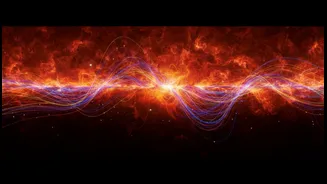
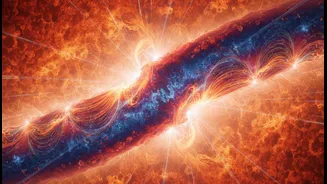
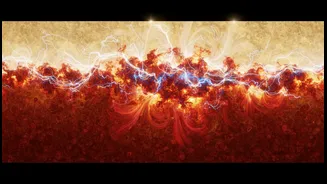
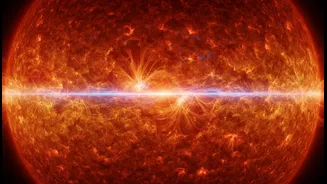
The defining feature of the tachocline is the dramatic clash of rotation it must manage. The inner radiative zone rotates like a solid object, with all parts taking roughly the same amount of time to complete one spin. However, the outer convection zone behaves like a fluid, exhibiting what's known as differential rotation: it spins much faster at its equator (about 25 days) than at its poles (about 35 days). The tachocline is the razor-thin region, less than 5% of the Sun's radius, where these two vastly different rotation styles meet. This creates an enormous amount of shear—a zone of intense friction and stretching as the fast-moving outer layers drag against the slower, rigid interior.
The Engine of Solar Magnetism
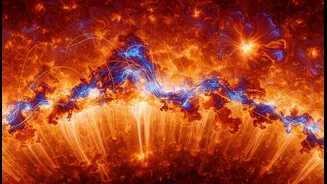
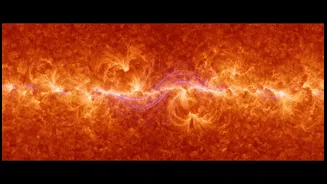
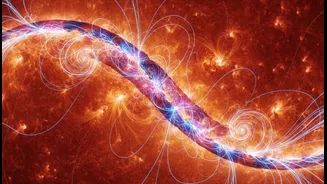
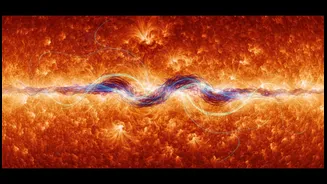
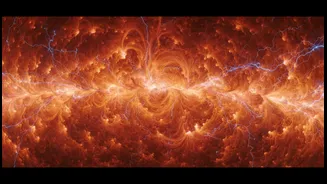
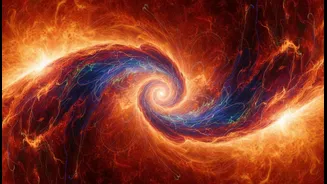
This intense shearing is widely believed to be the engine of the Sun's magnetic field, a process known as the solar dynamo. Think of a dynamo on a bicycle, which converts the kinetic energy of the spinning wheel into electrical energy to power a light. Similarly, the motion of the electrically charged plasma in the tachocline, stretched and twisted by the powerful shear, generates massive electrical currents. These currents, in turn, produce the Sun's colossal magnetic field. The tachocline takes weaker magnetic fields and stretches and amplifies them, winding them up into powerful, rope-like magnetic structures.
Why the Tachocline Matters on Earth
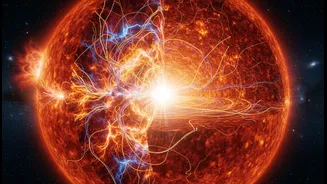
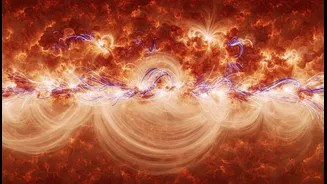
The magnetic field generated in the tachocline doesn't stay buried deep within the Sun. Eventually, these tightly wound magnetic field lines become unstable and buoyant, rising through the convection zone and bursting through the Sun's surface. This is the origin of nearly all solar activity that affects us on Earth. Sunspots, which are cooler, dark patches on the surface, are areas where these intense magnetic fields poke through. The snapping and reconnecting of these magnetic field lines can trigger solar flares and coronal mass ejections (CMEs)—enormous explosions that hurl radiation and charged particles into space. When aimed at Earth, this 'space weather' can disrupt satellites, damage power grids, endanger astronauts, and interfere with GPS and communication systems. The entire 11-year solar cycle, from periods of quiet to intense activity, is driven by this magnetic engine in the tachocline.