


A New Star Challenges the Heavens
Imagine looking up at the night sky and seeing a star where none existed before. That was the reality in early October 1604, when observers in Europe and Asia noted a dazzling new point of light in the constellation Ophiuchus. At its peak, it outshone
every star and even the planet Jupiter, remaining visible in the daytime for over three weeks. This event occurred just before the invention of the telescope, so all observations were made with the naked eye. The German astronomer Johannes Kepler began observing it on October 17 and tracked its changes for a full year, publishing his findings in a book titled 'On the new star in Ophiuchus's foot'. His detailed work was so influential that the event became known as Kepler's Supernova. Its appearance was a major problem for the established Aristotelian view that the heavens beyond the Moon were perfect and unchanging. This 'new star' provided powerful evidence that the cosmos was a far more dynamic place than previously believed.
What Kepler Actually Witnessed
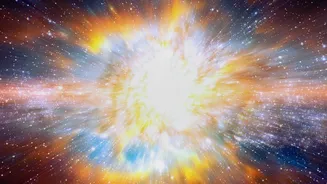
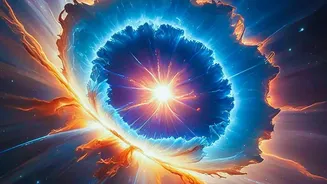
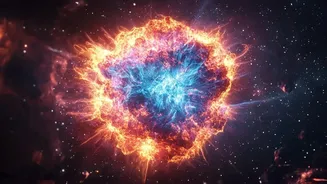
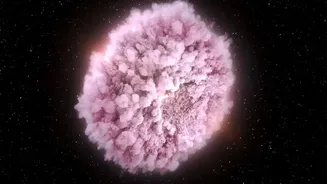
Centuries later, we know that Kepler didn't see the birth of a new star, but the violent death of an old one. SN 1604 was a Type Ia supernova, a specific kind of stellar explosion. These events typically happen in binary star systems where two stars orbit each other. One of the stars is a white dwarf—the super-dense, burnt-out core of a star that was once like our Sun. In what’s known as a 'single-degenerate' model, this white dwarf siphons material from its companion star, like a red giant. Over time, it accumulates so much mass that it surpasses a critical threshold known as the Chandrasekhar limit. This triggers a runaway thermonuclear reaction that completely obliterates the white dwarf in a titanic explosion, briefly outshining an entire galaxy. Nothing of the white dwarf is left behind.
The Modern Toolkit for Cosmic Forensics
Today, astronomers don't have to rely on the naked eye. They have a sophisticated toolkit to hunt for and analyze supernovae across the universe. Automated sky surveys constantly monitor vast patches of the sky, using computers to compare new images with old ones to spot the sudden appearance of new light sources. Once a candidate is found, the real investigation begins. One of the primary tools is photometry, which involves measuring the supernova's brightness over time. This creates a 'light curve', a graph showing how it brightens and fades. The distinct shape of the light curve helps astronomers classify the supernova type, such as distinguishing a Type Ia from other kinds of stellar explosions. Another crucial technique is spectroscopy, where light from the supernova is split into its constituent colors, like a rainbow. This spectrum reveals the chemical 'fingerprints' of the elements present in the explosion, such as silicon in Type Ia events, and tells scientists how fast the debris is expanding.
Revisiting the Scene of the Crime
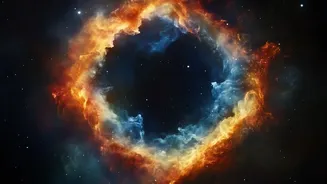
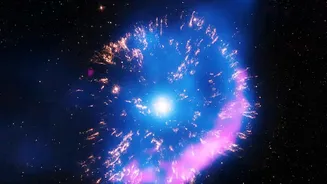
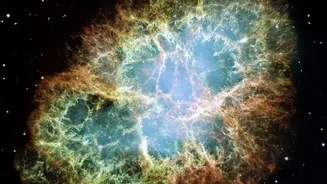
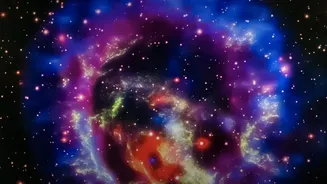
Even though the 1604 explosion is long over, its aftermath is not. Astronomers can point powerful modern instruments at its location, roughly 20,000 light-years away. What remains is a beautiful, expanding cloud of gas and dust called a supernova remnant. NASA's Great Observatories—the Hubble Space Telescope (visible light), Spitzer Space Telescope (infrared), and Chandra X-ray Observatory—have created stunning composite images of this remnant. These multi-wavelength views show a bubble of debris about 14 light-years wide, expanding at millions of miles per hour. Each telescope reveals different clues. Hubble sees the shock wave from the explosion slamming into surrounding interstellar gas. Spitzer detects heated dust particles. And Chandra maps out the extremely hot, iron-rich material ejected from the star's core. These observations have helped confirm it was a Type Ia event and even suggest the white dwarf's companion was an older, evolved star.
Why We Study These Explosions
Studying supernovae is about more than just witnessing cosmic fireworks. These explosions are fundamental to our existence. They are the universe's primary factories for heavy elements. While stars fuse lighter elements in their cores, it's the intense pressure and heat of a supernova that forges and scatters heavier elements like iron and nickel across the galaxy. This material enriches the interstellar medium, providing the raw ingredients for new generations of stars, planets, and even life. Furthermore, because Type Ia supernovae explode at a consistent mass, they have a remarkably uniform peak brightness. This makes them invaluable 'standard candles' for astronomers, allowing them to measure vast distances across the cosmos and map the expansion of the universe—a discovery that led to our understanding of dark energy.