



A Library Written in Ice
Imagine a place where snow that fell hundreds or even thousands of years ago remains perfectly preserved. In the vast ice sheets of Greenland and Antarctica, this is a reality. Each year, new layers of snow fall, burying and compressing the old ones.
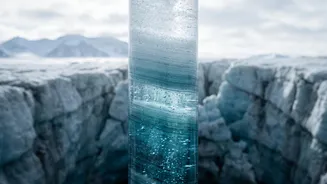
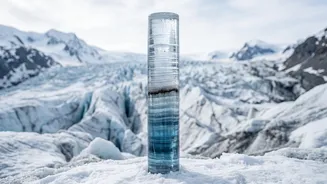
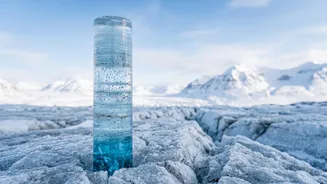
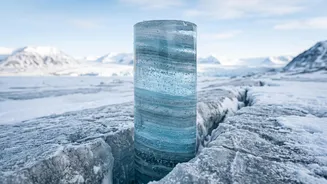
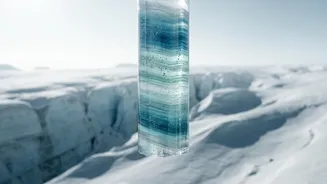
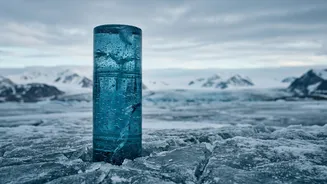
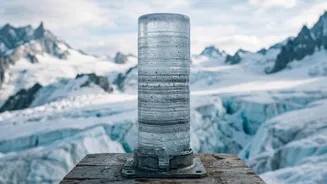
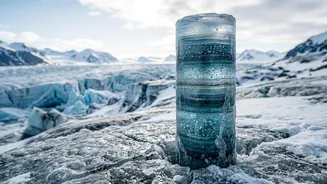
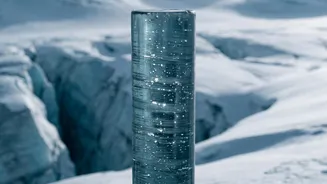
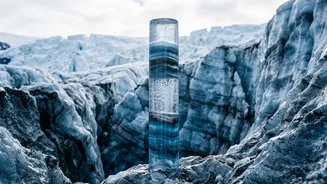
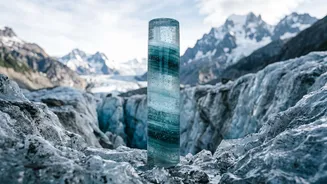
Over centuries, this immense pressure turns the snow into dense ice. Trapped within these layers are tiny bubbles of ancient air and particles that were floating in the atmosphere at the time, from dust to sea salt and, crucially, the fallout from major events. Scientists drill deep into this ice to extract long cylinders, known as ice cores. Some can stretch kilometres long, providing a year-by-year timeline of Earth's climate and atmospheric conditions stretching back as far as 800,000 years. These cores are like natural archives, allowing us to read the planet's past in breathtaking detail.
The Volcanic Fingerprint
When a large volcano erupts, it doesn't just spew ash and lava. It also blasts enormous quantities of gases high into the stratosphere, far above the weather. One of the most important of these is sulfur dioxide (SO2). Once in the stratosphere, the SO2 gas reacts with water molecules and oxygen to transform into tiny droplets of sulfuric acid (H2SO4). These droplets form a fine aerosol layer that can spread around the globe, reflecting sunlight back into space and causing a temporary cooling of the planet. Eventually, over months and years, these acid aerosols fall out of the atmosphere, often carried down by snow. In the polar regions, this acid-laden snow becomes another layer in the ever-growing ice sheet.
Reading the Chemical Clues
This deposition of sulfuric acid is the key to tracking ancient volcanoes. Because the volcanic acid is much more concentrated than the natural background levels of sulfate, it creates a distinct and easily identifiable spike in the ice core's chemistry. In the lab, scientists can melt the ice core layer by layer and analyse its chemical composition. A sharp increase in acidity or sulfate concentration is a tell-tale sign of a major volcanic eruption. By counting the annual layers down from the surface, researchers can date these eruption events with incredible precision. If the same acidic spike appears in ice cores from both Greenland and Antarctica, it's strong evidence of a massive, climatically significant tropical eruption whose fallout spread across the entire globe.
The Story of Recovery
But the ice doesn't just record the eruption itself; it also documents the aftermath. The layers of ice deposited in the years after the initial acid spike tell the story of the atmosphere's recovery. Scientists can see the concentration of volcanic sulfate gradually decrease in the subsequent annual layers. This tapering-off effect allows them to measure how long it took for the stratosphere to cleanse itself of the volcanic aerosols and return to its normal state. Typically, this process takes a few years, as atmospheric processes slowly remove the reflective haze. By studying dozens of these events frozen in time, scientists can build a detailed understanding of how the Earth's atmospheric system responds to and recovers from massive, sudden shocks.
Why Ancient Blasts Still Matter
Studying volcanic eruptions from thousands of years ago is more than just a historical exercise. This data provides a crucial baseline for understanding our planet's climate sensitivity. By seeing how the climate responded to major aerosol injections in the past, scientists can refine the models used to predict future climate scenarios. This includes understanding the potential impacts of future large eruptions, which are a natural and recurring part of the Earth's system. The detailed recovery timelines preserved in the ice give us a unique window into the planet's natural resilience, offering invaluable lessons from the deep past for navigating our present and future.