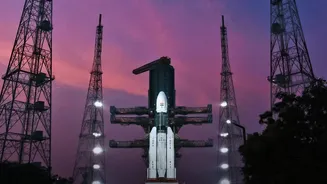




India's New 'Eye in the Sky'
First, let's understand what the EOS-05 satellite is. Formally known as GISAT-1A, it is a powerful geo-imaging satellite designed to be India's persistent eye over the subcontinent. Unlike satellites in Low Earth Orbit that pass over a location only periodically,
EOS-05 is positioned in a high-altitude Geosynchronous Orbit (GSO) nearly 36,000 kilometres up. From this vantage point, it can continuously monitor the same broad geographical area. Its mission is critical: providing near real-time imagery to track fast-developing natural disasters like cyclones and floods, monitor agricultural patterns, and offer crucial data for strategic and security purposes. With the ability to revisit specific locations at very short intervals, it represents a significant upgrade in India's remote sensing capabilities.
The Conventional Path to Orbit
Traditionally, getting a satellite to a geostationary orbit is a marathon, not a sprint. A rocket typically launches the satellite into what’s called a Geosynchronous Transfer Orbit (GTO). Think of this as a highly elliptical parking orbit. Its closest point to Earth (perigee) is very low, while its farthest point (apogee) is way out at the final desired altitude of around 36,000 km. From here, the satellite is on its own. Over a period of several weeks, sometimes even months, it must fire its small onboard engines repeatedly at the apogee to gradually raise its perigee, pushing the orbit into a perfect circle. This slow, fuel-intensive process means a long wait before the expensive asset can begin its operational life.
ISRO's Orbital Expressway Strategy
The strategy for EOS-05 was designed to dramatically shorten this journey. Instead of the standard GTO, ISRO's powerful GSLV rocket did more of the heavy lifting. It injected EOS-05 into a more optimized 'sub-GTO' where the apogee was already perfectly placed, and the perigee was significantly higher than in a conventional launch. This gave the satellite a massive head start. Instead of weeks of orbit-raising maneuvers, EOS-05 needed just a few precisely calculated firings of its Liquid Apogee Motor (LAM) over a handful of days to circularize its orbit and settle into its designated slot. This 'direct injection' approach is the different strategy the headline refers to—it trades a more complex launch profile for incredibly rapid deployment.
The Strategic Need for Speed
So, why does this speed matter so much? For a satellite like EOS-05, being operational in days versus weeks is a strategic game-changer. Imagine a cyclone forming rapidly in the Bay of Bengal or a sudden flash flood event in the Himalayas. With the conventional method, a newly launched satellite might still be on its slow journey to its final orbit, unable to help. With ISRO's new strategy, the satellite becomes a usable asset almost immediately, providing vital data when it is most needed. This rapid deployment capability enhances India’s agility in disaster management and its ability to respond to urgent national security situations, ensuring that its eyes in the sky are open for business when every minute counts.
A Story of Resilience and Redemption
The success of the EOS-05 mission is made even more significant by its history. This mission is essentially a second attempt. In August 2021, a nearly identical satellite, EOS-03, was lost during launch after the GSLV rocket's cryogenic upper stage malfunctioned. The failure was a major setback, but ISRO's scientists and engineers undertook a rigorous failure analysis and implemented corrective actions. The successful launch of EOS-05 using the same complex launch profile is a powerful testament to the space agency's resilience and deep-seated engineering expertise. It demonstrates a core principle of space exploration: learning from failures to achieve even greater successes.