







A New Era of Cosmic Meteorology
The dream of understanding alien weather is rapidly becoming a reality. In recent months, data from powerful observatories like the James Webb Space Telescope (JWST) has given scientists an unprecedented toolkit for studying the atmospheres of exoplanets.
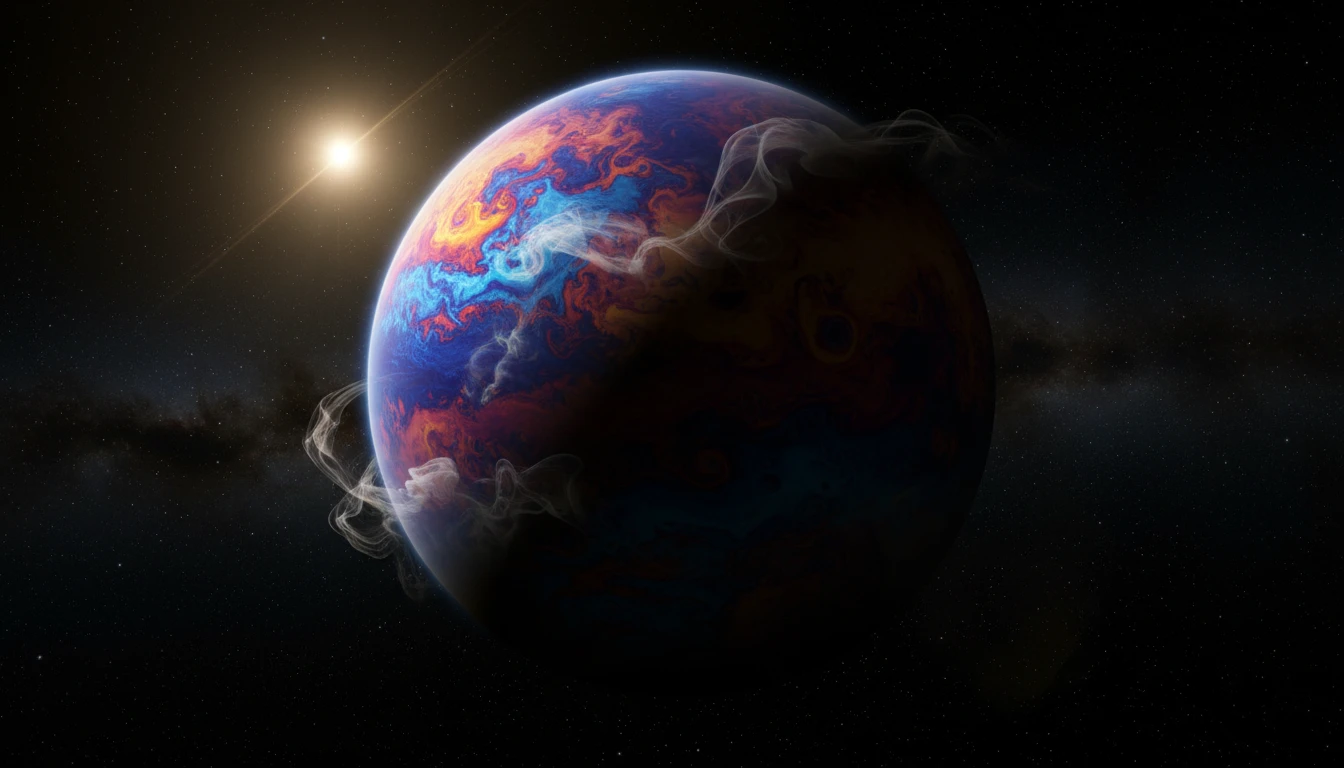
These are not just blurry images; this is detailed information that allows researchers to create weather maps for worlds hundreds of light-years away. For instance, recent studies of a class of exoplanets known as 'hot Jupiters'—gas giants orbiting perilously close to their stars—have revealed fascinating and extreme weather patterns. One study focusing on the planet WASP-94A b has shown a world with a striking daily weather cycle, where mornings are thick with clouds that dissipate by the evening. This isn't a one-off; similar cloud cycles have now been spotted on other hot Jupiters, suggesting that planet-wide weather systems can be detected and understood.
How to Read an Alien Sky
So how do scientists take the temperature of a planet they can never visit? The primary method is called transit spectroscopy. When an exoplanet passes in front of its star from our perspective, a tiny fraction of the starlight filters through the planet's atmosphere. Different chemical elements and compounds in that atmosphere absorb light at specific wavelengths, leaving a unique chemical fingerprint. The James Webb Space Telescope is exceptionally good at reading these fingerprints. By analyzing this light, astronomers can identify gases like water vapour, methane, and even the components of alien clouds. In the case of WASP-94A b, the data was so detailed that scientists could distinguish between the light coming through the planet's morning and evening sides as it rotated, revealing the asymmetric weather pattern.
Glimpses of Distant Storms
The findings are painting a picture of worlds with truly extreme weather. On tidally locked hot Jupiters, where one side perpetually faces the star's blistering heat and the other is in permanent night, scientists expected to find powerful winds. But new research has turned up a surprise: on the hottest of these planets, the winds are actually slower than models predicted. The leading theory is that these planets have powerful magnetic fields that are acting as a brake on the wind, a phenomenon totally unlike the weather systems on Earth. On another world, WASP-121 b, observations suggest temperatures on the dayside are hot enough to vaporize metals, which are then blown to the nightside where they may condense and fall as iron rain. Other planets show evidence of silicate clouds—essentially clouds of sand.
From Weather to Habitability
While studying 2,000-degree worlds that rain iron might seem esoteric, these discoveries are crucial steps in the much larger search for life. A planet's atmosphere and its climate are deeply connected to its potential to host life as we know it. By understanding the physical processes that govern atmospheres on hot Jupiters, scientists can refine the models they use to predict the climates of smaller, rockier, and potentially more Earth-like worlds. For example, recent observations of the rocky exoplanet LHS 1140b suggest it might still possess an atmosphere, a key ingredient for habitability. Detecting an atmosphere is the first step; understanding its weather is the next. Learning to distinguish between a sterile atmosphere and one bearing the chemical signatures of life—or biosignatures—is the ultimate goal.