




The Universe’s Most Precise Clocks
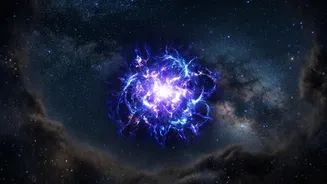
The key to this massive undertaking lies with pulsars, specifically a type known as millisecond pulsars. These are the super-dense, collapsed cores of massive stars that went supernova long ago. What makes them special is their incredibly rapid and regular
rotation. As they spin hundreds of times per second, they sweep beams of radio waves across space, much like a lighthouse. From our vantage point on Earth, these beams are observed as pulses of radiation with a regularity so precise they rival atomic clocks. This clock-like nature allows scientists to predict the arrival time of each pulse with astonishing accuracy. Any deviation from that schedule, no matter how minuscule, signals that something has affected the pulse on its long journey to Earth.
A Galaxy-Sized Gravitational Wave Detector
Astrophysicists from collaborations like the North American Nanohertz Observatory for Gravitational Waves (NANOGrav) realized they could use these pulsars to hunt for one of the most elusive phenomena in the cosmos: low-frequency gravitational waves. Predicted by Albert Einstein, gravitational waves are ripples in spacetime itself, created by cataclysmic events like the merging of supermassive black holes. These waves stretch and squeeze the fabric of space as they travel. By monitoring an array of dozens of pulsars spread across the galaxy, scientists create what is known as a Pulsar Timing Array. As a gravitational wave passes between Earth and a pulsar, it alters the distance the radio pulse must travel, causing it to arrive slightly earlier or later than expected.
A Decade of Diligent Observation
The headline's 'ten years of data' refers to the painstaking work of projects like NANOGrav, which recently published findings from their 15-year dataset, and the European Pulsar Timing Array (EPTA). Using powerful radio telescopes, researchers recorded the arrival times of pulses from 68 different pulsars. This long-term monitoring is crucial because the gravitational waves they are searching for have wavelengths that are light-years long, with periods that can last for years or even decades. The challenge was immense: scientists had to account for every other possible source of timing 'noise', from interference in the interstellar medium to the motion of the Earth itself, to isolate the specific signature of gravitational waves.
The Verdict: A Cosmic Hum Confirmed
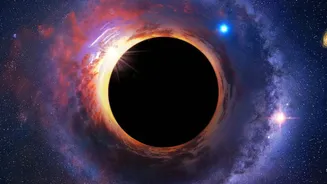
After more than a decade of data collection and analysis, the NANOGrav team announced compelling evidence for a gravitational-wave background. This is not a signal from a single event but a persistent, low-frequency 'hum' from the combined chorus of countless pairs of supermassive black holes orbiting each other throughout the universe before they merge. The data revealed a specific pattern of correlation between the timing shifts of different pulsars that matches the signature predicted by Einstein’s theory of general relativity for a gravitational wave background. This discovery opens a completely new window on the universe, allowing us to study events that are invisible to traditional telescopes.
Beyond Einstein: Probing New Physics
While the findings provide another stunning confirmation of Einstein's theories, they also pave the way to test 'extreme physics'. The incredible precision of pulsar timing arrays allows scientists to search for tiny deviations from general relativity that might hint at new, undiscovered physical laws. These datasets are now being used to place constraints on alternative theories of gravity and even to search for evidence of cosmic strings or other exotic phenomena predicted to have occurred in the early universe. By analyzing the properties of this cosmic hum, researchers can learn about the population of supermassive black holes, how galaxies form and merge, and the fundamental nature of spacetime itself.