






The Admin: NASA's Master Plan
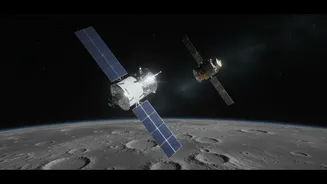
At the center of this cosmic conversation is NASA, acting as the group admin. The agency’s official strategy is called the Moon to Mars program, with the Artemis missions serving as the crucial first steps. The plan is elegantly logical: before we can
sprint to Mars, we need to learn how to walk, and eventually live, on the Moon. This multi-stage approach involves returning humans to the lunar surface to test technologies, establish infrastructure, and understand the challenges of long-duration spaceflight far from Earth. The successful uncrewed Artemis I and the crewed Artemis II lunar fly-by in April 2026 have already demonstrated core capabilities of the Orion spacecraft and SLS rocket. Now, the focus shifts to more complex missions, like Artemis III, which will involve testing landers in Earth orbit, and Artemis IV, which aims for a lunar landing in 2028. This isn't just about planting a flag; it's about building a sustainable proving ground for the much longer and more perilous journey to the Red Planet.
The Ride-or-Die Besties: International Partners
No ambitious project gets far without allies, and NASA has invited the world to join the chat. Through the Artemis Accords, a set of principles for cooperation in space, dozens of countries have signaled their commitment to the mission. This isn't just a symbolic gesture; international partners are providing critical hardware and expertise. The European Space Agency (ESA) is supplying the service module for the Orion spacecraft, which provides power and propulsion. The Canadian Space Agency (CSA) is contributing advanced robotics for the Gateway, a planned small space station in lunar orbit that will act as a staging point. Meanwhile, the Japan Aerospace Exploration Agency (JAXA) is developing a pressurized rover, allowing astronauts to conduct longer-range explorations on the lunar surface. This global collaboration defrays the immense costs and brings diverse talent to the table, transforming the Mars quest into a truly international endeavor.
The Tech Billionaires Who Crashed the Party
The 21st-century space race has a new set of players: private companies. Unlike the Apollo era, NASA is now actively leveraging commercial innovation to accelerate its goals. In a major strategic shift, the agency is treating deep space missions like a delivery service. A groundbreaking partnership announced in June 2026 will see Relativity Space build, launch, and operate a mission to deliver a NASA-made weather instrument to Mars in 2028. This approach allows NASA to focus on building scientific tools while private industry handles the transport, theoretically increasing the frequency of missions while lowering costs. Companies like SpaceX and Blue Origin are contracted to develop the human landing systems needed to get astronauts from lunar orbit to the Moon's surface. This public-private model injects competition and agility into the process, essentially creating a parallel conversation within the larger group chat focused on getting things done faster and more efficiently.
The Year-Long Video Call: Practicing on Earth
Before sending people to Mars for years, it's wise to check if they can handle the isolation and stress. That's the purpose of CHAPEA (Crew Health and Performance Exploration Analog), a series of year-long missions where volunteers live in a 3D-printed simulated Mars habitat in Houston. The first mission concluded on July 6, 2024, after 378 days. The second is currently underway and will finish in October 2026. Inside the 'Mars Dune Alpha' habitat, the four-person crew faces realistic challenges like communication delays, resource limitations, and simulated equipment failures. They conduct spacewalks, grow crops, and perform maintenance, all while researchers study their physical and psychological well-being. The data gathered from CHAPEA is invaluable, providing crucial insights that will shape everything from habitat design to mission protocols for the real trip to Mars.