




The Cosmic Family Portrait
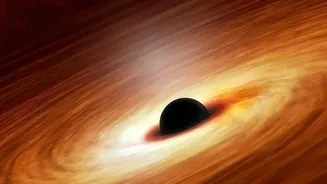
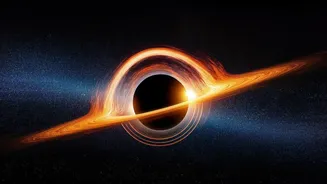
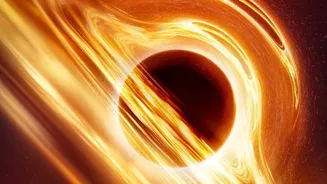
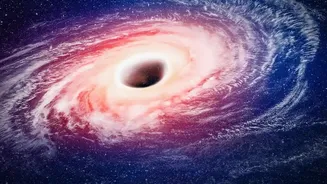
Imagine a family photo of all the black holes in the universe. On one side, you have the relatively small ones, known as stellar-mass black holes, typically weighing in at a few to a few dozen times the mass of our sun. They're the abundant, well-documented
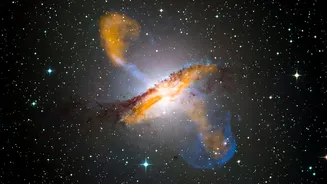
members of the family, formed from the collapse of massive stars. On the other side are the supermassive black holes, true behemoths that can be millions or even billions of times more massive than the sun, lurking in the hearts of most large galaxies, including our own Milky Way. For decades, astronomers have stared at this portrait and noticed a glaring gap: where are the 'middle children'? This missing class, called intermediate-mass black holes (IMBHs), with masses ranging from 100 to 100,000 times that of the sun, proved incredibly hard to find. Their existence was predicted, but without concrete evidence, our understanding of how supermassive black holes grow from smaller seeds remained incomplete.
Listening to Spacetime's Echo
The breakthrough came not from seeing, but from listening. In 1916, Albert Einstein predicted that when massive objects accelerate through space, they create ripples in the very fabric of spacetime itself. He called them gravitational waves. Think of it like dropping two bowling balls into a calm pond; the waves they create as they spiral towards each other and collide spread outwards. For a century, these waves were purely theoretical because the ripples from even the most cataclysmic cosmic events are astonishingly small by the time they reach Earth. That changed with the advent of the Laser Interferometer Gravitational-Wave Observatory (LIGO) in the United States and its partner, Virgo, in Italy. These incredibly sensitive instruments are L-shaped detectors, miles long, that can measure distortions in spacetime far smaller than the width of a proton. When a gravitational wave passes through, it ever so slightly stretches and squeezes the distance between mirrors at the ends of the detectors, a change that can be measured and interpreted.
The Chirp of a Cosmic Giant
On May 21, 2019, the LIGO and Virgo detectors picked up a signal unlike any before. It was a short, powerful burst of gravitational waves labeled GW190521. The signal came from the violent merger of two black holes. By analyzing the frequency and amplitude of the 'chirp', scientists could calculate the masses of the colliding objects. The results were stunning. The two black holes weighed in at approximately 85 and 66 times the mass of the sun. They merged to form a new black hole with a mass of about 142 suns, with the remaining energy, equivalent to eight solar masses, blasting out across the universe as gravitational waves. This was a landmark discovery for two reasons. Firstly, the resulting 142-solar-mass black hole was the first definitive detection of an IMBH. Secondly, the heavier of the two colliding black holes was itself so massive that it shouldn't have been able to form from a single collapsing star, hinting at a history of previous mergers.
Assembling the Cosmic Jigsaw
The detection of GW190521 and other subsequent IMBH candidates has opened a new chapter in astrophysics. These 'missing link' black holes are crucial for understanding the evolution of the universe. One leading theory for how supermassive black holes get so big is through hierarchical merging: smaller black holes merge over cosmic time, gradually building up to the giants we see today. IMBHs are the perfect stepping stone in this process. They could form in the heart of dense star clusters through repeated collisions and mergers, or from the collapse of the very first, gigantic stars in the universe. These IMBHs would then sink to the center of their young galaxies, merging with others and accreting gas to eventually become a supermassive black hole. By detecting the gravitational wave echoes of these IMBH mergers, scientists can essentially create a census of this once-invisible population, testing theories of galaxy formation and tracing the life cycle of black holes from birth to maturity.