



Beyond Just Finding Planets
For decades, the hunt for exoplanets—planets orbiting stars other than our Sun—was a game of detection. Scientists celebrated each new discovery, growing the catalogue of known worlds from a handful to thousands. But now, the field is undergoing a profound
shift. It's no longer enough to know a planet is there; scientists want to know what it’s like. This has given rise to exometeorology, the study of alien weather. Thanks to incredible new technology, we are moving from discovering dots of light to characterizing dynamic, three-dimensional worlds with their own unique climates, winds, and chemical cycles. This evolution marks a new business sector in space exploration: the detailed analysis and modeling of distant atmospheres, turning abstract data into tangible environmental knowledge.
How to Read Alien Air
You can't exactly place a weather station on a planet 400 light-years away, so how is this done? The primary technique is called spectroscopy. When an exoplanet passes in front of its star from our point of view, a tiny fraction of the starlight filters through the planet's atmosphere. Powerful telescopes can capture this light and analyze its spectrum. Different molecules in the atmosphere absorb specific wavelengths, or colors, of light, leaving behind a unique chemical fingerprint. By reading these absorption lines, astronomers can deduce the ingredients of the planet’s air—detecting elements like water vapor, methane, sodium, or even the minerals that form clouds of sand or salt. This foundational data is the first step toward building a complete weather profile for a distant world.
From Ingredients to a 3D Weather Map
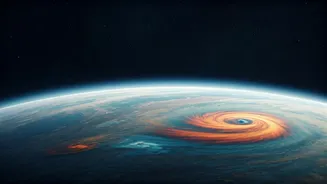
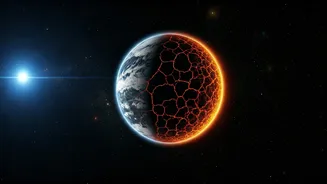
Knowing the chemical makeup is just the start. The real magic happens when this data is fed into sophisticated computer climate models, similar to those used for forecasting on Earth. By combining atmospheric composition with information about the planet’s size, orbit, and the heat from its star, these models can simulate and predict atmospheric dynamics. In recent years, this has allowed scientists to create the first 3D temperature and weather maps of exoplanets. For instance, on the ultra-hot Jupiter WASP-121b, astronomers mapped out extreme winds and vertical air currents, revealing a weather system unlike anything in our solar system. On another, WASP-18b, they mapped a scorching hot spot surrounded by a cooler ring, a direct result of being tidally locked to its star.
The Game-Changer: The James Webb Space Telescope
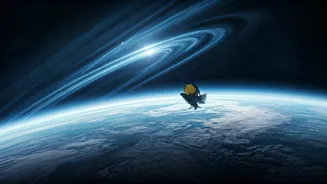
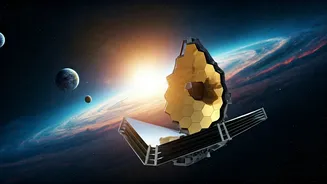
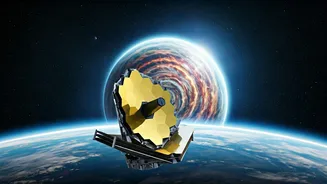
The single biggest catalyst for this new scientific frontier is the James Webb Space Telescope (JWST). Its massive mirror and extreme sensitivity to infrared light make it exceptionally good at capturing the faint light filtered through exoplanet atmospheres. Before JWST, detecting atmospheric components was difficult and often limited. Now, it's becoming routine. The telescope's precision has enabled breakthroughs like the first 3D temperature map of an exoplanet using a technique called spectroscopic eclipse mapping. It has detected methane in the atmosphere of a planet orbiting a dead star and even found salty clouds on a distant 'Pink Planet'. This flood of high-quality data is what has truly elevated alien weather forecasting from a theoretical exercise into an observational science.
Why Forecast for a World We'll Never Visit?
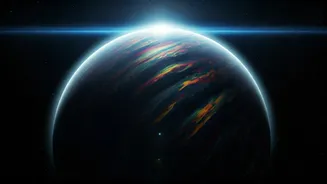
Forecasting sapphire clouds or iron rain on a planet trillions of kilometres away may seem purely academic, but it serves a critical purpose. Understanding the weather on a diverse range of planets helps scientists test and refine their models of atmospheric physics. What they learn can even improve weather and climate models for Earth. Furthermore, this research is a key part of the search for life. By identifying the atmospheric conditions on thousands of worlds, astronomers can better pinpoint which planets might have environments suitable for liquid water, a key ingredient for life as we know it. Future missions, like the European Space Agency's ARIEL telescope, are being designed specifically for this purpose, aiming to survey the atmospheres of around 1,000 exoplanets to create a grand census of planetary climates.