
A Storm Within a Storm
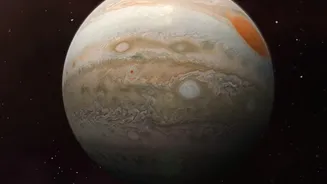
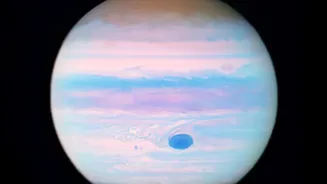
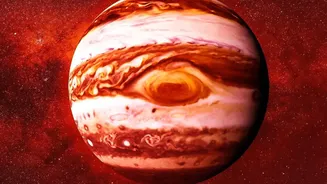
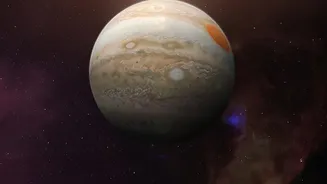
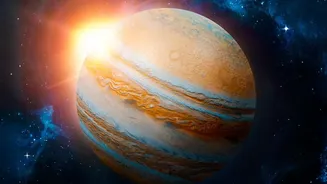
When we think of Jupiter's Great Red Spot, we often picture a single, massive entity. However, the reality is far more complex and dynamic. The Great Red Spot is an anticyclone, a region of high pressure that has been swirling in Jupiter's southern hemisphere
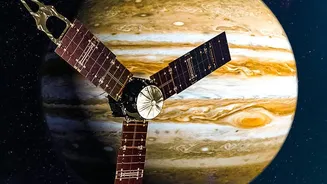
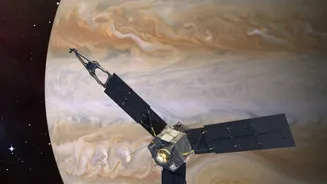
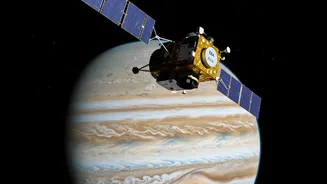
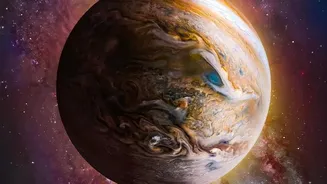
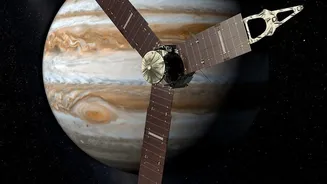
for at least 150 years, and possibly much longer. But it's not alone. The area is a bustling hub of atmospheric activity, filled with smaller vortices and eddies—think of them as smaller-scale storms or 'cosmic tornados'—that interact with the main event. These smaller storms are not just passive bystanders; they play a crucial role in the life and evolution of the Great Red Spot itself, feeding into it, and perhaps determining its ultimate fate. For years, scientists have used missions like NASA's Juno spacecraft to get a three-dimensional view of Jupiter's atmosphere, revealing that these storm systems are much deeper and more complex than previously imagined.
The Great Shrinking Spot
One of the biggest mysteries surrounding the Great Red Spot is that it's shrinking. Observations dating back to the late 1800s show a storm that was once vast enough to swallow three Earths, spanning some 39,000 kilometres. Today, it's just over a third of that size, measuring around 14,000 kilometres across. While still large enough to fit our entire planet inside, its contraction has accelerated in recent years, baffling astronomers. This has led to speculation about whether the iconic storm could one day disappear entirely. The shape has also changed, morphing from a distinct oval into a more circular form. This shrinking isn't necessarily a simple decline; studies have shown the storm is also growing taller as its width decreases, indicating a complex transformation is underway.
A Diet of Smaller Storms
So what do the smaller 'cosmic tornados' have to do with the Great Red Spot's diet plan? A recent study offers a compelling explanation: the Great Red Spot maintains its size by feeding on these smaller storms. Using sophisticated computer simulations, researchers found that when the Great Red Spot merges with and absorbs smaller vortices, it gets a vital energy boost that helps sustain it. According to this model, the current shrinking phase may be due to the iconic storm not having enough of these smaller storms to 'eat'. The research, led by Caleb Keaveney of Yale University, suggests that the frequency and strength of these interactions directly impact the Great Red Spot's ability to maintain its massive size. This theory was partly inspired by similar phenomena on Earth, where long-lived high-pressure systems, sometimes known as 'heat domes', are sustained by interactions with smaller weather events.
What This Means for Jupiter and Earth
Understanding the mechanics of the Great Red Spot does more than just solve a planetary puzzle; it enhances our broader knowledge of atmospheric physics. The dynamics on Jupiter, a gas giant with no solid surface to create friction, offer a unique laboratory for studying how storms can persist for centuries. The powerful jet streams on the planet play a huge role in its weather, but the interplay between large and small vortices is a key piece of the puzzle. The discovery that the Great Red Spot is heated from below by acoustic waves generated by its own turbulence adds another layer of complexity. Furthermore, the insights gained from studying Jupiter's storms can even help us better understand our own planet's weather systems. While vastly different, the underlying principles of fluid dynamics that govern a heatwave on Earth and a colossal storm on Jupiter share common ground.