



A Decades-Old Solar Puzzle
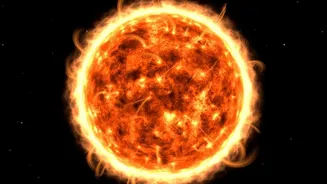
For nearly a century, solar physicists have grappled with the coronal heating problem. Logic suggests that as you move away from a heat source, the temperature should drop. Yet, on the sun, the opposite happens. The visible surface, or photosphere, is incredibly
hot, but the tenuous atmosphere extending millions of kilometres into space is hundreds of times hotter. This defies simple explanation and indicates that some unknown mechanism is actively pumping energy into the corona. For years, scientists have theorized that the sun's powerful and complex magnetic field must be responsible, acting as a colossal energy transport system. However, finding direct proof of how this energy is delivered and converted into heat has been a monumental challenge.
Enter the High-Frequency Wave
A major breakthrough may have just arrived, thanks to the European Space Agency's Solar Orbiter spacecraft. A team of researchers, led by scientists at Peking University, have announced the discovery of a previously hidden population of high-frequency plasma waves rippling through the sun's polar regions. These are a specific type of wave known as magnetohydrodynamic, or Alfvénic, waves. While scientists have detected slower, lower-frequency waves for years, those waves didn't appear to carry enough energy to account for the corona's extreme temperatures. This newly observed population, however, is different. It's fast, energetic, and was hiding in plain sight, just beyond the detection capabilities of older instruments.
Catching a Glimpse of the Invisible
The reason these waves remained elusive for so long is due to their speed and scale. They are small and oscillate incredibly quickly, making them a blur to most solar telescopes. The Solar Orbiter's Extreme Ultraviolet Imager (EUI) was the key to finally spotting them. Thanks to its high-resolution optics and its ability to take images in rapid succession—with a cadence of just five seconds—the instrument could resolve the fine, rapidly evolving structures. By analyzing data focused on the sun's north pole, the team was able to identify thousands of these wave events propagating outwards through bright, ray-like structures of plasma known as coronal plumes. What was once a fuzzy, indistinct region became a dynamic environment teeming with energetic waves.
How the Waves Supercharge the Corona
The operating theory is that these waves transfer energy from the sun's churning surface up into the corona. Imagine the sun's magnetic field lines as a vast network of guitar strings. The turbulent motion at the sun's surface continuously 'plucks' these strings, sending vibrations—the Alfvénic waves—shooting outwards. These waves travel along the magnetic field lines into the much less dense plasma of the corona. According to theoretical models, high-frequency waves are particularly effective at dissipating their energy in this environment. As the waves travel, they create turbulence that effectively dumps their energy into the surrounding plasma, causing it to heat up dramatically. This discovery provides the first strong observational evidence to back up what theorists have long suspected.
The Missing Piece of the Puzzle
The significance of this finding lies in the sheer amount of energy these high-frequency waves carry. When the research team calculated the energy flux, they found it was roughly 2.6 times greater than the energy measured from lower-resolution observatories. More importantly, the power found in the high-frequency range was more than double that of the lower-frequency waves that were already known to exist. This suggests that scientists have finally located the 'missing' energy required to explain the corona's intense heat. While other phenomena, like a constant fizz of tiny solar flares called 'nanoflares', may also contribute to coronal heating, this discovery confirms that high-frequency waves are a major player in solving this enduring solar mystery.