







The Ultimate Safety Net
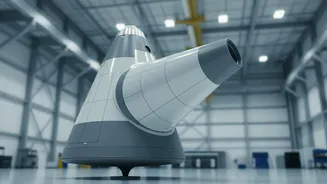
The Crew Escape System (CES) is essentially a high-powered ejector seat for the entire astronaut capsule, known as the Crew Module. Its sole purpose is to pull the module and its occupants away from the launch vehicle in the event of a catastrophic failure
on the launchpad or during the initial ascent. This system comprises a set of powerful, quick-acting solid motors designed to fire in an instant, propelling the crew to a safe distance before their parachutes deploy for a gentle landing. Given that the launch phase is one of the most dangerous parts of any space mission, perfecting this system isn't just an objective; it's a non-negotiable prerequisite. Every component must work flawlessly, every time, under the most extreme conditions imaginable.
Trial by Fire: The Pad Abort Test
One of the first major hurdles was the Pad Abort Test (PAT), successfully conducted back in July 2018. This test simulated an emergency right on the launchpad. The 12.6-tonne crew module, using its own escape motors, was launched from the Satish Dhawan Space Centre. It reached an altitude of 2.7 km before safely parachuting down into the Bay of Bengal about 2.9 km from the launch site. The entire sequence lasted just over four minutes but was a monumental step, proving the fundamental concept and capability of the escape system to function as designed in a ground-level emergency.
Simulating Mid-Air Emergencies: The TV-D1 Mission
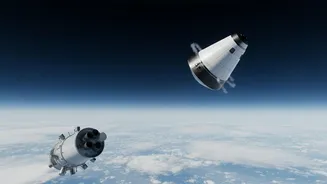
The next critical phase involved testing the escape system during flight. The Test Vehicle Abort Mission-1 (TV-D1), conducted in October 2023, was designed for this very purpose. A special test rocket launched the uncrewed Gaganyaan crew module to an altitude of about 17 km. At a specific point, travelling at Mach 1.2 (slightly above the speed of sound), an abort was deliberately triggered. The Crew Escape System fired, pulling the module away from the rocket. The module then descended under its parachutes, splashing down safely in the Bay of Bengal, where it was recovered by the Indian Navy. Despite a minor initial hold in the launch sequence, the mission was declared a resounding success, validating the system's performance at high altitude and transonic speeds.
Perfecting the Landing: A Symphony of Parachutes
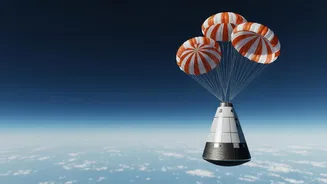
Getting the crew away from a failing rocket is only half the battle; bringing them down safely is the other. The Gaganyaan Crew Module relies on a complex sequence of 10 parachutes to ensure a soft landing. This system is qualified through a series of Integrated Main Parachute Airdrop Tests (IMAT). In these tests, a mass equivalent to the crew module is dropped from an Indian Air Force IL-76 or Chinook helicopter from an altitude of 2.5 to 3 km. The sequence begins with smaller parachutes that pull out the main ones in a 'reefed' or partially open state to manage the initial shock, before they fully open to slow the module for a gentle splashdown. ISRO has conducted multiple such tests, including the second Integrated Air Drop Test (IADT-02) in April 2026 and another main parachute test in July 2026, each time validating the system under different conditions and confirming the reliability of this critical hardware.
The Rigorous Road Ahead
The successful abort tests and parachute drops are major milestones, but they are part of a much larger, exhaustive testing campaign. ISRO continues to conduct static fire tests of the various escape motors and plans further test vehicle missions, like the upcoming TV-D2, to simulate aborts under even more complex conditions. Each test, from ground-based motor firings to high-altitude demonstrations, generates invaluable data, allowing engineers to refine models and be absolutely certain of the system's performance. This meticulous, step-by-step approach ensures that when Indian astronauts finally strap into the Gaganyaan capsule, they will be protected by one of the most rigorously tested safety systems in the world.