



What to Look For
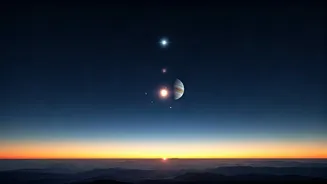
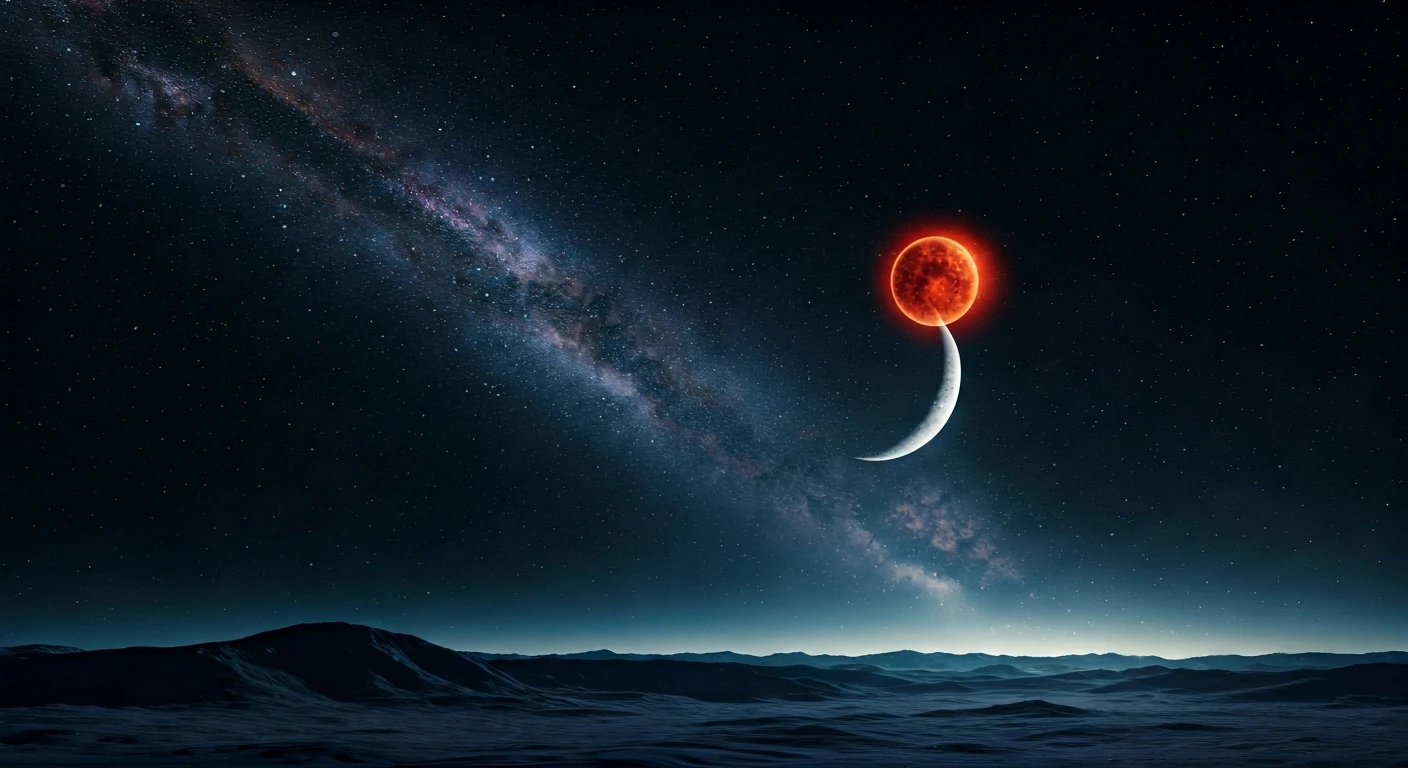
As darkness falls this evening, step outside and direct your gaze towards the southern sky. You will see the Moon, our constant celestial companion. Very close to it, you'll spot a distinctly reddish, twinkling point of light. That isn't a planet or a plane;
it's Antares, one of the brightest stars in our sky. The two will appear strikingly close, a phenomenon known as a conjunction. Depending on your exact location and the time you're observing, the Moon might even pass directly in front of the star, an event called an occultation. For most observers in India, they will appear as cosmic neighbours, separated by a tiny sliver of sky.
Meet Antares: A Fiery Giant
So, who is this star sharing the stage with the Moon? Antares is no ordinary star. It is a red supergiant, a true behemoth of the cosmos. Located about 550 light-years away in the heart of the constellation Scorpius, Antares is mind-bogglingly huge. If you were to place it where our Sun is, its outer edges would extend past the orbit of Mars and reach into the asteroid belt. Its reddish hue is a tell-tale sign of its age and temperature; it's a cooler, older star nearing the end of its life, destined to one day explode in a spectacular supernova. Its name, Antares, is derived from ancient Greek and means "rival of Ares," with Ares being the Greek god of war, known to the Romans as Mars. This is because its fiery red colour often caused it to be mistaken for the planet Mars.
How to Watch This Celestial Date
The best part about this event is its accessibility. You don’t need any fancy equipment. The Moon and Antares are both bright enough to be seen with the naked eye, even from moderately light-polluted urban areas. Simply find a spot with a clear view of the southern horizon. The show begins shortly after sunset and will be visible for several hours as the pair traverses the night sky.
For an enhanced view, grab a pair of binoculars. Through them, the Moon's craters and seas will pop into view, and the colour of Antares will be even more pronounced. You might also be able to spot other stars in the distinctive, hook-shaped constellation of Scorpius. If you have a small telescope, you can get a truly magnificent view, but it’s by no means necessary to enjoy the spectacle.
A Matter of Perspective
When you see the Moon and Antares appearing so close, it’s important to remember that this is a line-of-sight illusion. The Moon is our cosmic next-door neighbour, located about 3,84,000 kilometres away. Antares, on the other hand, is an astonishing 550 light-years away. That’s a distance of roughly 5.2 quadrillion kilometres. The star is more than 13 billion times farther away from us than the Moon is.
They appear together in our sky simply because, from our vantage point on Earth, they happen to align along the same line of sight at this particular moment. It’s a beautiful reminder of the three-dimensional nature of our universe and how our perspective shapes what we see. These conjunctions happen periodically as the Moon makes its monthly journey across the ecliptic, the path the Sun, Moon, and planets follow across our sky.