

Our Dazzling Evening Star
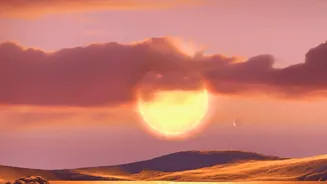
Throughout August 2026, Venus is dominating the early evening sky. Often called the 'Evening Star' (or 'Morning Star' when it appears before sunrise), it's the third-brightest object in our sky after the Sun and the Moon. Its steady, piercing light makes
it unmistakable, easily outshining any actual star. This month, you can find it shining brightly in the west after the sun goes down, a beautiful beacon in the twilight. It will remain a prominent evening feature through September and into October, making this a great season for sky-gazers across India.
The Science of Its Shine
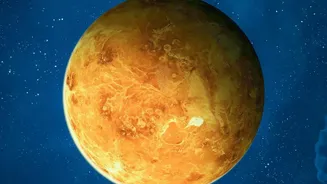
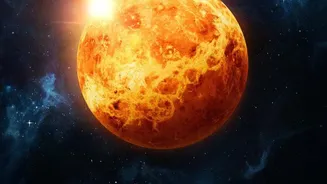
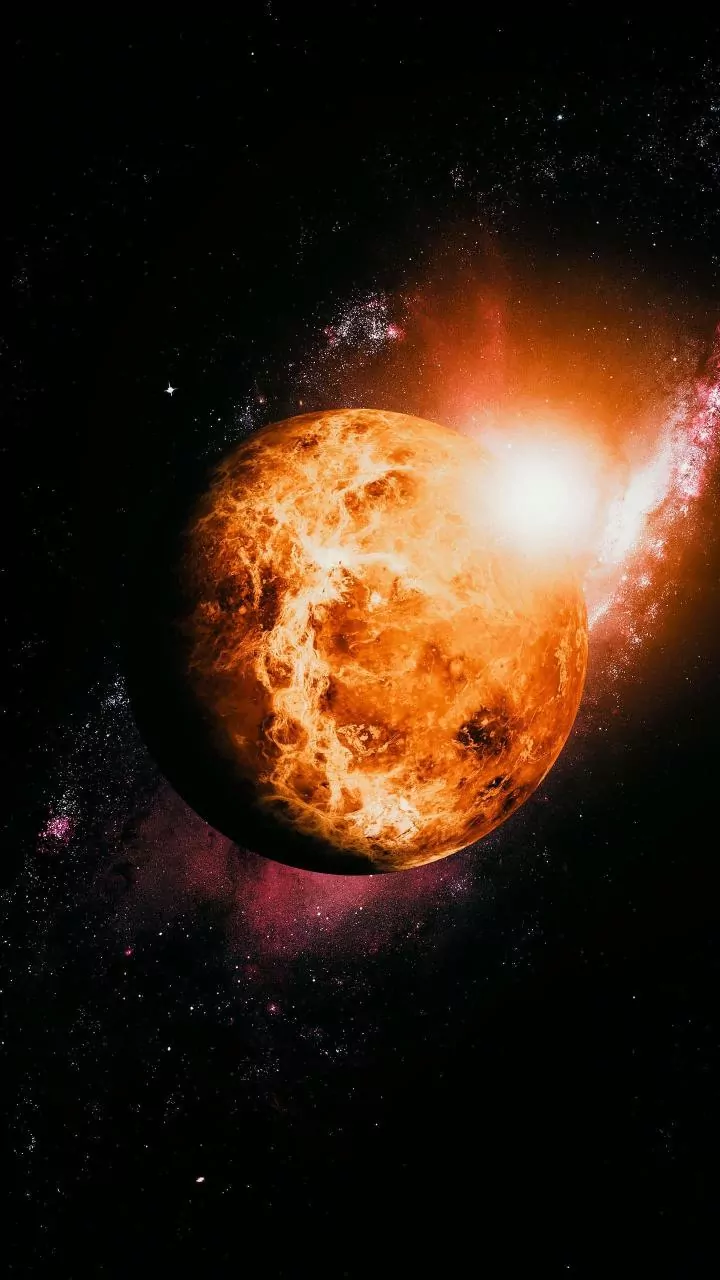
So, what gives Venus its celebrity status in the night sky? It's a combination of three key factors. First is its incredibly reflective atmosphere. Venus is blanketed by thick clouds of sulfuric acid droplets that are highly effective at scattering sunlight. About 70-76% of the sunlight that hits Venus is reflected back into space, a property known as high albedo. For comparison, Earth reflects about 30%, and the Moon's rocky surface reflects only about 10% of sunlight. Second is its proximity. Venus is our closest planetary neighbour, and this closeness means the light it reflects doesn't have as far to travel to reach our eyes. This combination of being both close and highly reflective is the secret to its brilliant appearance.
An August 2026 Viewing Guide
This August is a particularly good time to observe Venus. On August 15th, it reached what astronomers call its 'greatest eastern elongation'. This is the point in its orbit where it appears farthest from the Sun in our sky from our perspective on Earth, making it hang higher and longer in the evening twilight. For all of August, you simply need to look to the western sky after sunset to find it. You won't need any special equipment; its brightness makes it easily visible to the naked eye, even from cities with some light pollution. As the month progresses, watch for Venus to get closer to the bright star Spica, in the constellation Virgo, setting up a conjunction in early September.
The Phases of Venus
Just like our Moon, Venus goes through phases. Because its orbit is inside of ours, we see different amounts of its sunlit side as it travels around the Sun. When it's on the far side of the Sun from us, it appears nearly full but small. As it gets closer to Earth, its apparent size increases, but its phase wanes into a crescent. Around its greatest elongation in mid-August, Venus appears about half-illuminated through a telescope, similar to a first-quarter moon. Interestingly, Venus actually appears at its most brilliant not when it's full, but when it's a large, slender crescent, a point it will reach in mid-September. This is because even though less of it is lit, it is much closer to Earth, making its overall apparent brightness peak.
Beyond the Naked Eye
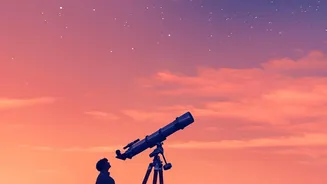
While Venus is a stunning sight with just your eyes, even a simple pair of binoculars can enhance the experience. Binoculars will help you see that Venus is a distinct disk, not a pinpoint of light like a star. A small telescope will reveal even more, allowing you to track its changing phases from month to month. For instance, in early August 2026, it appeared as a gibbous disk, but by the end of the month, it will be a noticeably thicker crescent. This ability to see its phases is a rewarding experience for any amateur astronomer and a direct observation of our solar system in motion.