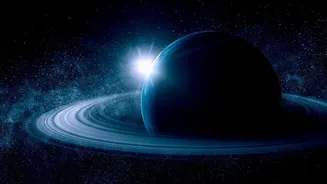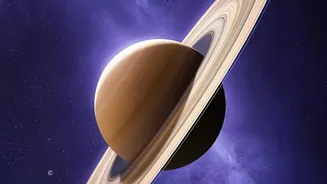


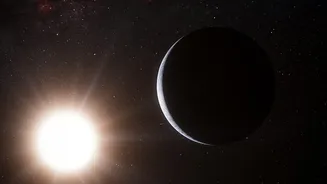

In a cosmic mystery 1,000 light-years away, a planet being watched by astronomers appeared to vanish. After disappearing from view in March 2026, scientists now believe they have solved the case of the missing world.
The Case of the Disappearing Planet
For seven years, from 2019 to early
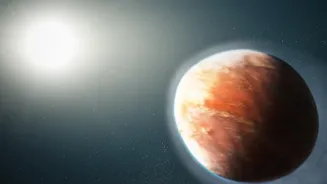
2026, astronomers using NASA's Transiting Exoplanet Survey Satellite (TESS) had a bead on a distant world named TOI-2535 b. Located about 1,000 light-years from Earth, this massive planet is classified as a 'hot Jupiter'—a gas giant orbiting incredibly close to its star. It completes a full year in just over eight Earth days. TESS tracks planets by detecting the faint, regular dip in a star's light as a planet 'transits' or passes in front of it from our viewpoint. But with TOI-2535 b, astronomers noticed something strange. Its schedule was erratic, with transits sometimes occurring up to six hours early or six hours late. Then, in March 2026, the signal stopped entirely. The planet, it seemed, was gone.
A Gravitational Tug-of-War
The solution to the puzzle isn't that the planet was destroyed or flew out of its system. Instead, new research suggests it was simply hidden from view by a cosmic neighbour. A team of astronomers, led by researchers from the University of California, Los Angeles, determined that TOI-2535 b is not alone. It's locked in a gravitational battle with a nearby, unseen planet. This powerful interaction is causing the orbits of both planets to 'wobble' like spinning tops. Over time, this wobble tilted TOI-2535 b's orbit just enough that, from our perspective on Earth, it no longer passes in front of its star. It didn't disappear, it just moved out of our line of sight.
Not the First Ghost Planet
While the case of TOI-2535 b has a new explanation, it echoes another famous cosmic mystery: Fomalhaut b. First detected in 2004, Fomalhaut b was celebrated as one of the first exoplanets to be directly imaged. But it was always a strange object, unusually bright in visible light but with no heat signature in the infrared. Over the years, it began to fade, and by 2014, Hubble observations showed it had vanished. In that case, the solution was even more dramatic. Scientists concluded Fomalhaut b was never a planet at all. What they had witnessed was the expanding aftermath of a titanic collision between two massive, icy bodies, each about 200 kilometres wide. The bright point of light was a massive dust cloud that has since expanded and faded beyond detection.
What These Mysteries Teach Us
Both of these 'missing' planets reveal how dynamic and chaotic other star systems can be. The solution for TOI-2535 b confirms that planets in the same system can dramatically influence each other's orbits. This kind of 'wobble' is similar to why Earth doesn't have a solar or lunar eclipse every single month; the Moon's orbit is slightly tilted relative to Earth's. The case of Fomalhaut b provided a rare, real-time look at how planets can be destroyed, a process thought to be a key part of how planetary systems form and evolve. These events, whether it's an orbital tilt or a catastrophic collision, challenge the idea of a 'clockwork' universe, showing instead that planetary systems are constantly changing.