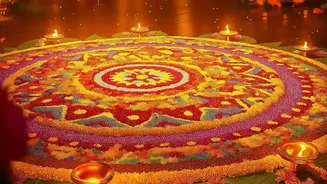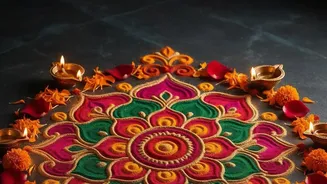







Every Diwali, thresholds across India bloom with intricate patterns, a welcoming gesture of light and artistry. But these designs, collectively known as rangoli, are more than just decoration; they are a vibrant map of India's diverse folk art heritage.
An Art of Welcome and Auspiciousness
At its heart, the tradition of drawing patterns on the floor during Diwali is a symbolic act of welcome. These designs are meant to invite Goddess Lakshmi, the purveyor of wealth and prosperity, into the home. Far from being mere decoration, this art form, which dates back centuries, is a spiritual practice intended to bring good fortune, ward off evil spirits, and celebrate the victory of light over darkness. The patterns are ephemeral, often made with rice flour or coloured powders, designed to be swept away and renewed, symbolising life's transient nature. While broadly called rangoli, the specific styles, materials, and motifs vary dramatically from one region to another, each telling a unique cultural story.
South India’s Geometric Kolam
In South India, particularly Tamil Nadu, the daily ritual of drawing 'Kolam' becomes more elaborate during Diwali. Traditionally created by women at dawn, Kolam is a mathematically precise art form made with rice flour. The designs are composed of dots ('pulli') and a series of gracefully looping lines drawn around them, often in a single, unbroken stroke to symbolically prevent evil spirits from entering the home. The use of rice flour is an act of generosity, providing sustenance for ants, birds, and other small creatures. While typically white, red ochre borders are sometimes added for festive occasions. The motifs are often geometric or inspired by nature, like the lotus, which symbolises purity and divine presence.
Bengal's Fluid and Lyrical Alpana
In West Bengal, the floor art is known as 'Alpana'. Unlike the dry powders of rangoli or the dot-grid of Kolam, Alpana is created with a liquid paste of ground rice and water. Artists use their fingertips or a small piece of cloth to paint flowing, free-form designs on floors and courtyards. This art is intrinsically linked to auspicious occasions, especially Lakshmi Puja during Diwali. Common motifs include the divine footprints of Goddess Lakshmi, lotus flowers, fish, paisleys, and stalks of paddy, all symbols of prosperity and abundance. The designs are characteristically white against a natural floor, creating a delicate, lyrical effect that is distinctly Bengali.
Rajasthan’s Earthy Mandana
The arid landscapes of Rajasthan and Madhya Pradesh give rise to 'Mandana' paintings. This folk art is traditionally done by women from the Meena community on the mud walls and floors of their homes to protect the hearth, welcome gods, and mark festive celebrations like Diwali. The process involves preparing the ground with cow dung and red clay, creating a rich, earthy canvas. Using a rudimentary brush made from a date stick or a tuft of hair, intricate white patterns are drawn with chalk or lime powder. Mandana motifs are symbolic and can include peacocks, tigers, floral patterns, and depictions of Lord Ganesha.
Bihar's Ritualistic Aripana
Originating from the Mithila region of Bihar, 'Aripana' is another floor art form integral to rituals and festivals. Like Alpana, it is often made with a wet paste of ground rice, known as 'pittha'. Fingers are used to create line drawings that are both symbolic and decorative. For colour, artists may add vermilion or turmeric. Aripana designs range from images of gods and goddesses to tantric symbols, flowers, and animals. These patterns are considered essential for any ceremony to be complete and are believed to make the land fertile and fruitful.
Kumaon's Sacred Aipan
From the Kumaon region of Uttarakhand comes 'Aipan', a ritualistic art form distinguished by its red and white colour scheme. Traditionally, a red ochre base ('geru') is prepared on the floor or a wooden stool, and patterns are drawn on it using the white rice paste ('bisvar'). Aipan is drawn to commemorate auspicious occasions and is believed to provide protection from evil. Every Aipan design begins and ends with a dot, symbolising the centre of the universe. Motifs include footprints of goddesses, floral patterns, and geometric shapes, each passed down through generations from mother to daughter.