


A Tale of Two Theories
Modern physics rests on two incredibly successful, yet fundamentally incompatible, pillars. The first is Einstein's theory of general relativity, which describes gravity as the graceful curvature of a smooth, continuous fabric of spacetime. It works perfectly
for large objects like planets and galaxies. The second is quantum mechanics, which describes the other forces of nature as operating in a world of discrete, chunky packets, or 'quanta'. In the quantum realm, everything is pixelated. This conflict is one of the biggest unsolved problems in physics. To unite them, physicists have been searching for a theory of 'quantum gravity', which would describe how gravity works at the smallest possible scales.
What is 'Spacetime Graininess'?
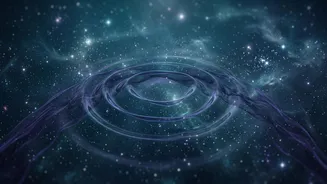
Many theories of quantum gravity predict that if you could zoom in to an absurdly small level—the so-called 'Planck length', a billionth of a trillionth of a trillionth of a centimetre—spacetime would stop being smooth. Instead, it would reveal a turbulent, bubbling texture often called 'spacetime foam' or 'quantum foam'. First proposed by physicist John Wheeler in 1955, this idea suggests that at this fundamental level, spacetime itself is subject to quantum fluctuations, constantly churning with tiny, fleeting distortions. If this were true, the very fabric of reality would be 'grainy', like the pixels of a screen.
Hunting for Pixels in Deep Space
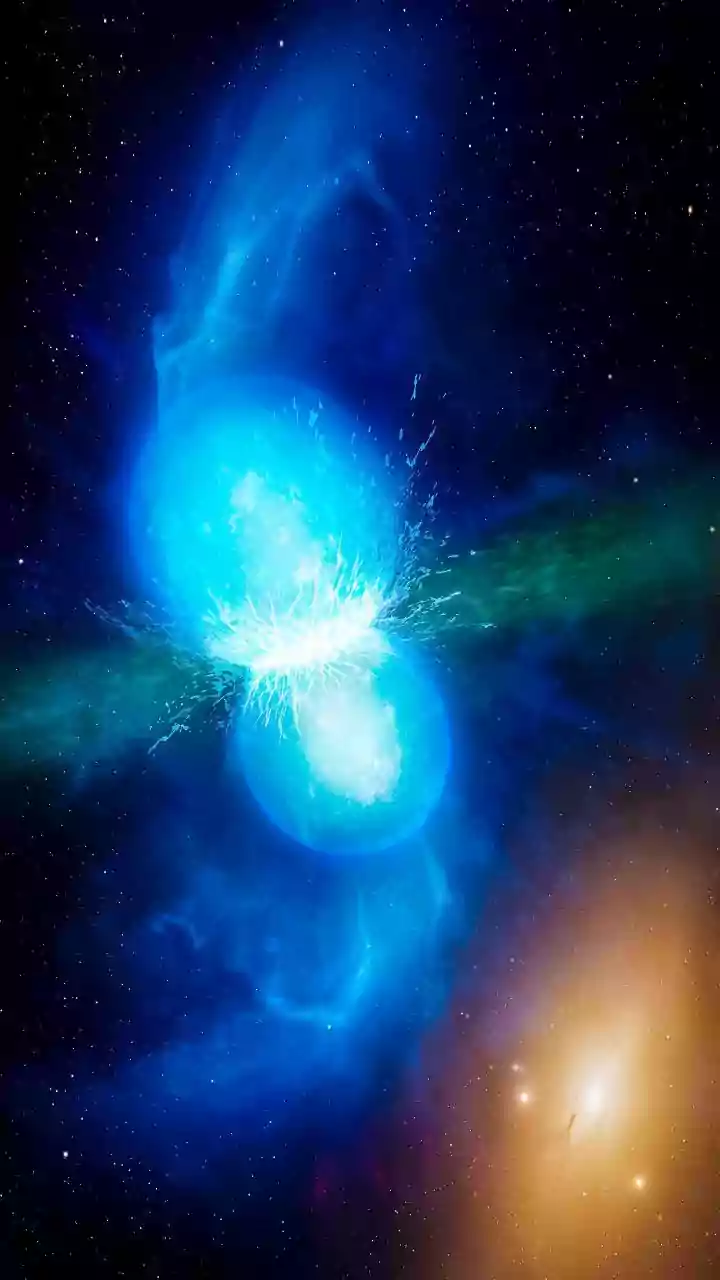
You can't build a microscope powerful enough to see the Planck length directly, so scientists have to get creative. One of the most popular methods involves looking at light from the most distant and powerful explosions in the universe: gamma-ray bursts (GRBs). These events, often caused by the collapse of massive stars, send torrents of light particles, or photons, across billions of light-years. According to some quantum gravity models, if spacetime is grainy, this foaminess should act like a cosmic fog, subtly affecting how light travels. Specifically, higher-energy photons (like gamma rays) should be slowed down ever so slightly more than lower-energy ones. Over a journey of billions of light-years, this tiny difference in speed should accumulate into a measurable delay.
A Smooth Verdict from the Cosmos
Scientists have been searching for this time lag for years, and the latest observations have delivered a powerful verdict. By analyzing the arrival times of photons from extremely distant gamma-ray bursts, researchers have found no evidence of the expected delay. Photons of different energies, launched from the same cosmic explosion billions of years ago, arrived at Earth at virtually the same time. This result suggests that if spacetime has any graininess at all, it must be on a scale much smaller than many popular theories of quantum gravity predicted. To the limits of our current ability to measure, spacetime appears to be perfectly smooth.
What Does This Mean for Physics?
These findings do not disprove the idea of quantum gravity. However, they do rule out some of the simpler models that predict a specific kind of energy–dependent speed of light. The 'spacetime foam' may be less foamy than previously thought, or its effects on light might be more complex and subtle than a simple speed delay. Physicists are now pushed to explore more sophisticated theories. The result is a classic example of how science progresses : an elegant idea was proposed , an experiment was devised to test it , and the results have now sent theorists back to the drawing board . The universe , it seems , is not quite as pixelated as we might have believed.