






A Mission of Historic Firsts
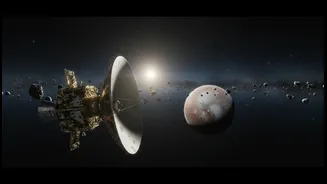
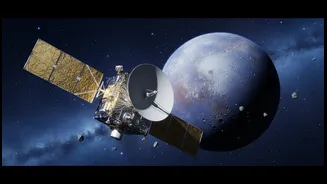
Launched in 2006, New Horizons is one of the fastest human-made objects ever built. Its primary goal was to conduct the first-ever up-close reconnaissance of Pluto. On July 14, 2015, it succeeded spectacularly, flying by the dwarf planet and its moons,
and transforming our understanding of these distant worlds. The data revealed Pluto as a stunningly complex and geologically active world, with vast nitrogen glaciers, towering mountains of water ice, and a thin blue haze of an atmosphere. But for the mission team, the Pluto flyby was just the beginning. The spacecraft was built for the long haul, with its sights set on an even more remote region: the Kuiper Belt, a vast donut-shaped ring of icy bodies left over from the formation of the solar system.
Beyond Pluto to Arrokoth
Following its success at Pluto, NASA extended the mission, sending New Horizons deeper into the Kuiper Belt. Its new target was a small, primordial object then known as 2014 MU69, later officially named Arrokoth. On January 1, 2019, the spacecraft performed a flawless flyby, making Arrokoth the most distant object ever explored by a spacecraft. The encounter was a triumph, revealing a bizarre, snowman-shaped object formed from two smaller bodies that had gently merged. This provided scientists with an unprecedented look at a perfectly preserved building block of the planets, a relic from the solar system's earliest days. Even this, however, was not the end of the road.
What is New Horizons Doing Now?
As of July 2026, New Horizons is continuing its journey through the Kuiper Belt, more than 5.9 billion miles from Earth. In late June 2026, the spacecraft successfully woke from a 321-day hibernation period, its longest yet, designed to save power during its long cruise. While hibernating, several of its instruments remained active, continuously collecting data on the charged particles of the solar wind and the dust environment of deep space. Now awake, the spacecraft is beaming this valuable information back to Earth—a process that takes nearly nine hours for a signal to travel one way. The mission's current focus is primarily on heliophysics, studying the sun's sphere of influence and how it interacts with the interstellar medium. This unique vantage point provides data unobtainable from anywhere else.
An Unexpectedly Dusty Road
The science doesn't stop. As it travels, New Horizons is essentially our most remote weather station, measuring the solar wind. Recent data shows the solar wind has slowed by about 13 to 15 percent at the spacecraft's current distance, a key insight into the sun's waning influence at the edge of the solar system. Even more intriguing, data from its dust counter suggests the Kuiper Belt might be far larger than previously thought. The probe has detected unexpectedly high levels of dust, hinting at a whole new population of colliding objects that extends much farther out, potentially revealing a second, more distant belt of icy bodies. This discovery could reshape our maps of the solar system's architecture.
The Future of a Deep-Space Explorer
Despite a brief funding scare for the 2026 budget, NASA has committed to extending the New Horizons mission until it exits the Kuiper Belt, likely in 2028 or 2029. While no suitable new flyby target has been identified yet, the search continues. Powerful observatories are scanning the skies along the probe’s path for another ancient world to visit. In the meantime, the mission will operate in a low-activity mode, preserving its precious plutonium power source and fuel while focusing on its groundbreaking heliophysics observations. The spacecraft remains healthy and is expected to have enough power to continue returning data well into the 2030s, following in the footsteps of the legendary Voyager probes into true interstellar space.