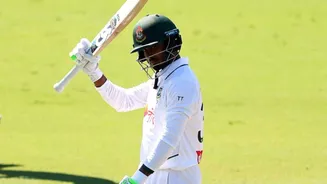








The Darwin Debacle
On a steamy Thursday at Marrara Stadium, Test cricket's return to Darwin after two decades turned into a nightmare for the home side. After winning the toss and batting, Australia were dismantled by a brilliant Bangladesh pace attack, folding for just
198. The chief destroyer was Hasan Mahmud, who claimed a career-best 6 for 55, becoming the first Bangladesh bowler to take a five-wicket haul in a Test in Australia. A gritty 71 from Steve Smith was the only significant resistance as his teammates struggled to build partnerships. The total of 198 marked Australia's lowest-ever Test score against Bangladesh, a grim statistic for a team beginning a crucial 12-month Test schedule. As Bangladesh’s batters comfortably navigated their way to stumps, the question was already being asked: where does this rank in the pantheon of Australian batting disasters?
The Modern-Era Meltdowns
While shocking, the Darwin score is numerically higher than some of Australia's most infamous modern collapses. Two dates are burned into the memory of Australian fans. The first is November 11, 2011, in Cape Town. In an astonishing passage of play, Australia were skittled for just 47 by South Africa. Debutant Vernon Philander took five wickets as Ricky Ponting, Mike Hussey, and Brad Haddin all went for ducks. It was Australia's fourth-lowest total in history and their worst since 1902. The other scar is from August 6, 2015, at Trent Bridge. In the fourth Ashes Test, Australia was blown away for 60 in just 18.3 overs, the shortest first innings in Test history. Stuart Broad delivered a mesmerising spell of 8 for 15, with the entire Australian innings so brief it could be typed out, ball-by-ball, in a single tweet. These two collapses represent the benchmark for modern batting futility.
More Than Just the Numbers
However, judging the 'worst' collapse isn't just about the final score. Context is crucial. The 47 in Cape Town and the 60 in Trent Bridge, while horrific, came against formidable pace attacks in overseas conditions known for being treacherous. The collapse in Darwin happened on home soil. It happened against a Bangladesh side that had never won a Test in Australia and was playing their first series there since 2003. The psychological impact of failing so spectacularly against a team you are heavily favoured to beat, in your own backyard, elevates the disaster. Numerically, 198 is far from their lowest score. But in terms of shock, embarrassment, and the sheer gulf between expectation and reality, the Darwin performance stands as a uniquely painful chapter in Australia's Test history.
The Anatomy of a Catastrophe
These events are never caused by a single factor. The Darwin innings showed a familiar fragility. Openers fell early, creating pressure on the middle order. Marnus Labuschagne's lean run continued, and a succession of batters were unable to support Smith. This pattern is a hallmark of major collapses: early wickets create momentum for the bowling side, which then becomes a psychological wave that is almost impossible to stop. In Cape Town in 2011, an incredible 23 wickets fell in a single day, showing how quickly a game can spiral out of control. At Trent Bridge, England had six slips, feasting on the edges that came from a combination of brilliant swing and seam bowling and tentative batting. In Darwin, it was Hasan Mahmud's consistent line and length that exposed a batting lineup that looked, for a day at least, alarmingly vulnerable.


![[WATCH] AUS vs BAN 2026: Taskin Ahmed pulls off one of the all-time celebrations after dismissing Cameron Green](https://g-mob.glance-cdn.com/public/content/assets/partner/images/f-a270977e8f-ca919bd6-a0ed-5c62-baae-a3e60294e4ab-image-178659600781684066.jpeg)