

An 'Almost Total' Lunar Eclipse
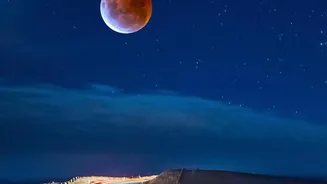
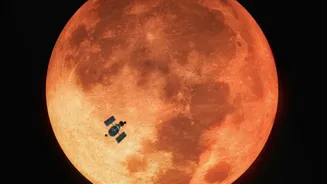
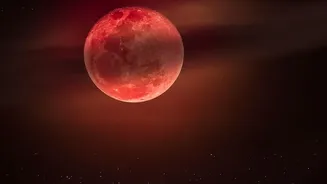
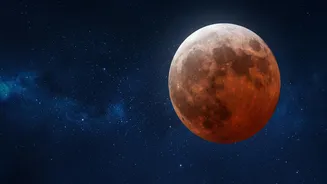
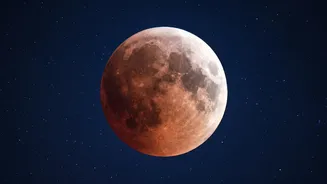
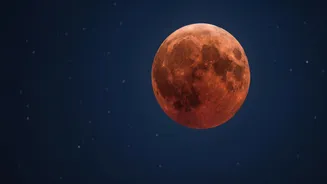
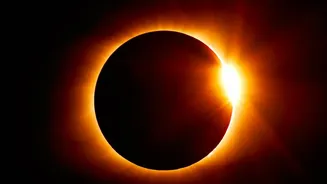
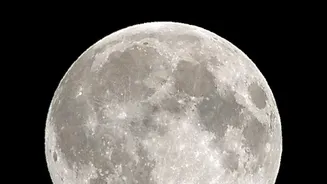
On Friday, August 28, 2026, Earth will pass directly between the Sun and the Moon, casting its shadow on the lunar surface. This event is a partial lunar eclipse, but an unusually deep one. At its peak, about 96% of the Moon's surface will be covered
by the darkest part of Earth's shadow, the umbra. This will leave only a tiny sliver of the Moon untouched, creating a sight that is very close to a total eclipse. For this reason, some are calling it an 'almost Blood Moon' because the eclipsed portion will likely take on a reddish, coppery hue. This colour comes from sunlight filtering through Earth's atmosphere, which scatters blue light and allows red light to pass through and illuminate the Moon.
Will It Be Visible From India?
Unfortunately for viewers in India, this dramatic celestial event will not be directly visible. The eclipse occurs entirely during daylight hours for the subcontinent. The partial eclipse phase will begin around 8:04 AM Indian Standard Time (IST) and reach its maximum point at approximately 9:43 AM IST. The event concludes around 12:32 PM IST. Since the Moon will be below the horizon throughout this entire period, it will be impossible to see the eclipse from anywhere in India. The event coincides with the festival of Raksha Bandhan, which has increased local interest in its timings.
How You Can Still Watch From India
Even though you can't step outside to see it, you don't have to miss out entirely. Several observatories and astronomy websites will host free live streams of the eclipse, allowing viewers in India to watch the event online. Timeanddate.com, Griffith Observatory in Los Angeles, and the Virtual Telescope Project are popular platforms that often provide live feeds of such celestial events. These streams will capture the view from regions where the eclipse is visible, such as North and South America, Europe, and Africa. This is the best way for Indian enthusiasts to witness the Moon slip into Earth's shadow in real-time.
Understanding the Science
A lunar eclipse, or Chandra Grahan, happens only during a full moon when the Sun, Earth, and Moon align perfectly. Earth's shadow has two parts: the faint outer shadow called the penumbra, and the dark inner shadow called the umbra. The eclipse begins when the Moon enters the penumbra, causing a subtle dimming that's hard to notice. The main event starts when the Moon moves into the umbra, creating the visible 'bite' out of the lunar disk. In a partial eclipse, only part of the Moon enters the umbra. This upcoming eclipse is notable because it passes so deeply into the umbra without being fully total.
Cultural Significance of a Chandra Grahan
In India, a Chandra Grahan holds deep cultural and spiritual significance. It is often viewed as a time for introspection and spiritual practices rather than material pursuits. Traditional beliefs, rooted in the mythological story of Rahu attempting to swallow the Moon, lead to various observances. Many people fast, chant mantras, and take ritual baths after the eclipse to purify themselves. Temples often close during the eclipse period and reopen after purification rituals. While the eclipse is not visible in India this time, and associated religious restrictions may not apply in the same way, the astronomical event remains a point of cultural interest.
A Note on Safe Viewing
For those in regions where the eclipse is visible, there's good news. Unlike a solar eclipse, a lunar eclipse is completely safe to view with the naked eye. No special glasses or filters are required to watch the Moon pass through Earth's shadow. In fact, using binoculars or a small telescope can provide a stunning, up-close view of the changing colours and shadows on the lunar surface. The darkness of the eclipse also provides a rare opportunity to see stars close to the full Moon, which are normally washed out by its brightness.