




A Name Born from Practicality
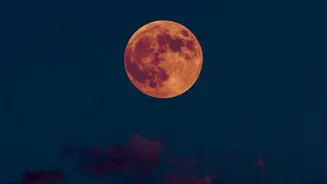
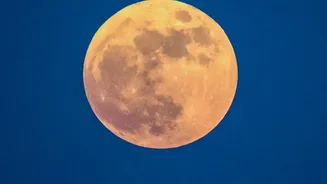
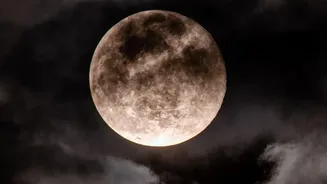
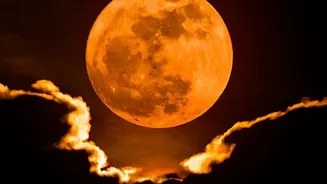
The most common name for October's full moon is the Hunter's Moon. This title isn't arbitrary but is deeply rooted in the practical realities of life in the Northern Hemisphere before the age of electricity. The name is widely attributed to Native American
peoples, particularly the Algonquin tribes of North America, who named the full moons to track the seasons. Colonial Americans later adopted these names, and they were popularized in the 1930s by publications like The Maine Farmer's Almanac. The earliest recorded use of the term 'Hunter's Moon' in English dates back to a 1710 publication, where it was attributed to 'the country people'. This name signifies a crucial time of year: the period to hunt and stock up on meat for the long, cold winter ahead.
The Harvest's Aftermath
The Hunter's Moon is intrinsically linked to the event that precedes it: the harvest. It is defined as the first full moon to follow the Harvest Moon. The Harvest Moon is the full moon occurring closest to the autumnal equinox. Once farmers had cleared their fields of crops, a unique opportunity arose for hunters. The bare fields left animals like deer, foxes, and other game with nowhere to hide as they foraged for leftover grains. This made them easier to spot and track. The animals were also at their most robust, having fattened up over the summer, which meant a more substantial supply of food for the winter. The timing was perfect, turning the post-harvest landscape into a prime hunting ground.
Illuminating the Hunt
A key characteristic of both the Harvest and Hunter's Moons is that they provide an abundance of light in the early evening. Typically, the moon rises about 50 minutes later each night, but around the time of the autumnal equinox, this difference shrinks to as little as 30 minutes for several consecutive evenings. This phenomenon occurs because the moon's orbital path forms a narrower angle with the horizon at this time of year. The result is a prolonged period of bright moonlight shortly after sunset, effectively extending the daylight. For hunters in past centuries, this extra light was invaluable, allowing them to continue their pursuit of game well after the sun had disappeared.
More Than Just One Name
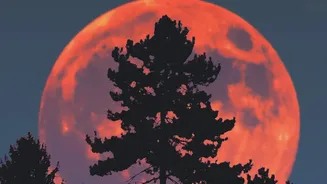
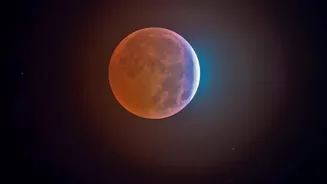
While 'Hunter's Moon' is the most widely recognized name in Western cultures, it is by no means the only one. Many cultures named the October moon based on their own local observations of nature. Some Native American groups also referred to it as the 'Dying Grass Moon', the 'Travel Moon', or the 'Falling Leaves Moon', all beautifully descriptive of the autumn season. Other names include the 'Sanguine Moon' or 'Blood Moon', which could refer to the blood of the hunt or the deep red colour of autumn leaves. It's important not to confuse this with the term 'Blood Moon' used for a total lunar eclipse. In Hindu culture, this full moon is celebrated as Sharad Purnima, a harvest festival marking the end of the monsoon season.
A Legacy in the Sky
Today, most of us don't rely on the moon to hunt for our winter provisions. Yet, the name 'Hunter's Moon' persists, connecting our modern world to a time when survival was intimately tied to the cycles of nature. It serves as a cultural echo of a season dedicated to preparation, resourcefulness, and acknowledging the transition from the abundance of autumn to the scarcity of winter. In some places, the tradition is actively celebrated; for example, the Feast of the Hunters' Moon is an annual historical reenactment held in Indiana. The name is a powerful reminder of how the sky, the land, and human life were once inextricably linked.