




More Than Just Dirt
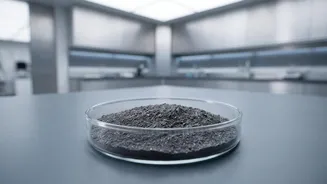
Unlike the soft, weathered dust on Earth, lunar dust—or regolith—is fundamentally different and far more dangerous. Formed over billions of years by micrometeorite impacts in a vacuum without wind or water to smooth its edges, each particle is a microscopic
shard of glass-like rock. These particles are not only incredibly sharp and abrasive but also carry an electrostatic charge, causing them to cling stubbornly to everything they touch. Apollo 17 commander Eugene Cernan called it "one of the most aggravating, restricting facets of lunar surface exploration." This isn't just an inconvenience; this abrasive, adhesive dust can wear through spacesuits, scratch helmet visors, clog mechanisms, and coat solar panels, drastically reducing their efficiency.
Lessons from the Apollo Era
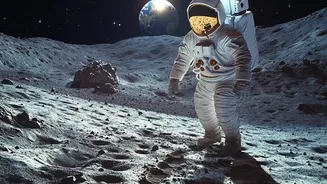
The Apollo missions provided NASA's first, and most potent, education on the perils of lunar dust. Astronauts found their spacesuits caked in the material, which was so abrasive it wore through layers of their boots. The dust caused seals on sample containers to fail and got into the joints of spacesuits, restricting movement and causing air leaks. Back inside the lunar module, the problem continued. With no effective way to clean their suits, astronauts brought the dust inside with them. Once in a breathable atmosphere, the fine particles floated around the cabin, causing some astronauts to experience symptoms like congestion and sore throats, dubbed "lunar hay fever." The experience proved that even short-term exposure was a major operational headache and potential health hazard.
Planning for a Permanent Presence
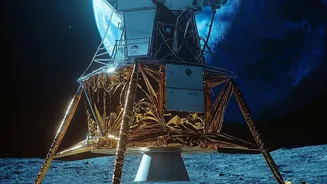
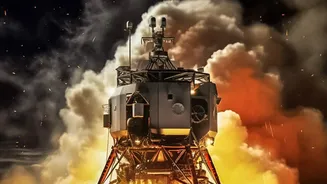
As NASA's Artemis program aims to establish a long-term, sustainable presence on the Moon, the dust problem has escalated from a nuisance to a critical mission risk. Equipment intended to last for years, not days, must withstand constant exposure. The threat is multifaceted. During landing, the rocket engine's plume can eject dust at high speeds, effectively sandblasting any nearby hardware or habitats. For long-duration missions, the dust's ability to degrade solar panels, radiators, and mechanical systems poses a direct threat to the viability of a lunar base. Protecting astronauts and their advanced equipment from this persistent hazard is a top priority, requiring a strategic, end-to-end approach to mitigation.
A Three-Pronged Attack on Dust
NASA's strategy for tackling lunar dust is a comprehensive, three-part plan that involves changing how they operate, as well as developing new technologies. The first, and most impactful, component involves architecture and operational planning. This can include everything from designing landing pads that minimise dust clouds to altering Extra-Vehicular Activity (EVA) procedures to reduce astronaut exposure. Recent research has also explored using "immature" regolith with coarser grains for roadways, which would kick up less dust. Another approach involves developing resins that can be sprayed onto the surface to stabilize the soil around landing sites and habitats. By thinking about dust from the very beginning of the mission design process, engineers can significantly reduce its impact.
The Technology of Tomorrow
The other two prongs of NASA's strategy involve passive and active technologies. Passive solutions include developing new materials, fabrics, and surface coatings that are inherently dust-resistant. Active technologies, which require power, offer more direct solutions. The most promising of these is the Electrodynamic Dust Shield (EDS). This system uses a network of transparent electrodes to create an electric field that actively repels or lifts dust particles from a surface. The technology is incredibly flexible and can be embedded in everything from the glass on a helmet visor to the fabric of a spacesuit or the surface of a solar panel. An EDS system was successfully tested on the Moon in 2025, proving its effectiveness at clearing dust from critical surfaces and marking a major step forward.