





Meet the Cosmic Misfit
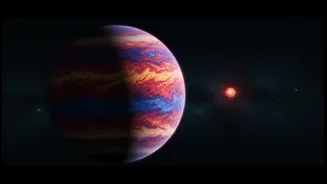
In the vast expanse of space, about 283 light-years away, lies a planetary system that has astronomers scratching their heads. The star, a cool red dwarf named TOI-5205, is tiny by stellar standards—only about 40 percent of the Sun's size and mass. Orbiting
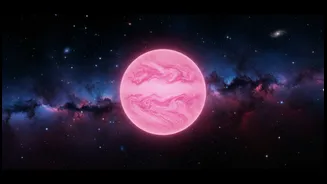
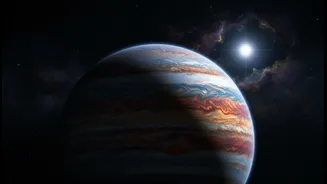
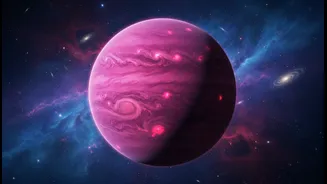
this small star is a behemoth of a planet: TOI-5205b, a gas giant roughly the same size as our own Jupiter. This pairing is profoundly strange. Finding a Jupiter-sized planet around a star this small is like finding a melon growing on a bonsai tree. The sheer difference in scale is so dramatic that according to our best understanding of planet formation, this system shouldn't exist.
The Standard Blueprint for Planets
For decades, the leading theory for how giant planets form has been the 'core accretion' model. Think of it as a cosmic construction project. It starts with a young star surrounded by a massive, spinning disk of gas and dust called a protoplanetary disk. Within this disk, tiny dust particles begin to stick together, like dust bunnies under a bed, gradually forming larger and larger clumps. Over millions of years, these clumps grow into a solid, rocky core. If this core becomes massive enough—about 10 times the mass of Earth—its gravitational pull becomes so strong that it begins to rapidly suck in the surrounding gas, ballooning into a gas giant. The key ingredient for this recipe is a large initial disk with plenty of raw material to build that massive core.
Not Enough Material to Build a Giant
This is where TOI-5205b becomes a 'forbidden planet.' Small, cool M-dwarf stars like its host are believed to form from much smaller, less massive protoplanetary disks than sun-like stars. The conventional wisdom was that these smaller disks simply don't contain enough rocky material to build a core massive enough to trigger the runaway gas accretion needed to form a Jupiter. By the time such a core could theoretically form, the gas in the disk would have long since dissipated. So, the existence of a gas giant as massive as TOI-5205b orbiting such a small star directly contradicts the predictions of the core accretion model.
An Alternative Assembly Line?
So, if the standard model doesn't work, how did this planet come to be? Astronomers are now looking more closely at an alternative theory known as 'gravitational instability' or 'disk instability'. This model proposes a much faster, more chaotic way to form a giant planet. Instead of a slow, bottom-up process, this theory suggests that the protoplanetary disk itself can become so massive and unstable that parts of it collapse directly under their own gravity, forming a giant planet in a relatively short timeframe—perhaps just thousands of years instead of millions. While core accretion is thought to explain most known planets, anomalies like TOI-5205b provide compelling evidence that this alternative, more dramatic formation pathway might be more common than previously assumed, especially in systems that seem to defy the rules.