






The Artemis Program: Gateway to Deep Space
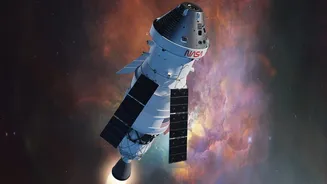
You can't talk about the future of exploration without talking about Artemis. More than just a return to the Moon, Artemis is NASA's ambitious program to establish a sustainable human presence on and around our nearest celestial neighbour. Think of it as
the ultimate deep-space proving ground. Every component, from the powerful Space Launch System (SLS) rocket and Orion spacecraft to the planned Gateway lunar outpost, is designed to test the technologies and strategies needed for eventual human missions to Mars. The program forces engineers to solve critical challenges like long-duration life support, protection from deep-space radiation, and operating complex systems far from home. By building a sustained presence on the Moon, NASA isn't just planting flags; it's creating a blueprint for how humanity will live and work on other worlds. The lessons learned and technologies perfected under Artemis will be the foundation upon which all future crewed interplanetary missions are built, making it arguably the most critical undertaking for the future of human spaceflight.
Europa Clipper: In Search of Habitable Worlds
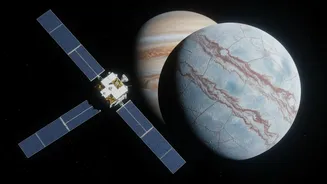
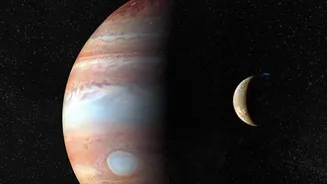
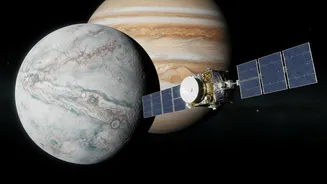
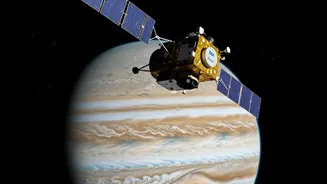
One of the most profound questions is whether we are alone in the universe. The Europa Clipper mission is designed to take a major step toward answering it. Having launched in October 2024, the spacecraft is currently on its long journey to Jupiter. In December 2026, it will perform a crucial Earth gravity-assist manoeuvre to slingshot it toward the outer solar system for its 2030 arrival. Its destination, Jupiter’s moon Europa, is one of the most compelling targets in the search for life. Scientists have strong evidence that a vast liquid water ocean, potentially containing twice as much water as all of Earth's oceans combined, exists beneath its icy shell. Europa Clipper won't be looking for life directly. Instead, it will perform dozens of close flybys, using a suite of advanced instruments to confirm the ocean's existence, measure its depth and salinity, and scan the surface for clues about its chemical composition. By determining if Europa has the three key ingredients for life—water, chemistry, and energy—the mission will tell us where to look next and could fundamentally alter our understanding of habitable environments in the cosmos.
Dragonfly: A Nuclear-Powered Drone on a Distant Moon
If Europa Clipper is about finding a habitable ocean, the Dragonfly mission is about exploring a world with the building blocks of life. Scheduled for a 2028 launch, this audacious mission will send a car-sized, nuclear-powered rotorcraft to Saturn's largest moon, Titan. Unlike any rover before it, Dragonfly will be able to fly from one location to another, covering tens of kilometres in a single flight through Titan’s dense, nitrogen-rich atmosphere. This mobility is key to its mission: studying prebiotic chemistry. Titan is a bizarrely Earth-like world, with a weather system, rivers, and lakes, but they are all based on liquid methane and ethane instead of water. Its atmosphere is rich with complex organic molecules that rain down on the surface, creating a world-sized laboratory for the chemistry that precedes life. Dragonfly will land in various locations, including ancient impact craters where water ice may have melted and mixed with these organics in the past. By sampling these materials, Dragonfly will give scientists an unprecedented look at the chemical pathways that could, under the right conditions, lead to life.
Mars Sample Return: Bringing the Red Planet to Earth
For decades, we have sent robotic emissaries to study Mars from afar. The Mars Sample Return (MSR) mission aims to close the loop. NASA's Perseverance rover has already collected and sealed dozens of compelling rock and soil samples in the Jezero Crater, an area believed to have once been a river delta. The challenge now is getting them home. The original MSR plan proved too costly and complex, forcing a major redesign. NASA is currently at a critical juncture, evaluating new, more efficient architectures, with a final decision on the path forward expected in the latter half of 2026. Despite the programmatic hurdles, the scientific payoff is considered immense. Bringing pristine samples of Mars back to Earth would allow scientists to analyze them with state-of-the-art equipment far too large and complex to send to another planet. This analysis could definitively answer whether microbial life ever existed on Mars, reveal the planet's geological history, and provide essential information for planning the safety of future human astronauts. The success of MSR is a critical next step in our exploration of the Red Planet.