


From Niche Sport to Mainstream Movement
Nordic walking originated in Finland as an off-season training method for elite cross-country skiers in the 1930s. For decades, it remained a specialised technique for athletes to maintain upper-body strength and endurance when there was no snow. However,
in recent years, this activity has exploded in popularity, embraced by everyone from seniors seeking low-impact exercise to fitness enthusiasts looking for a more efficient workout. This shift from a specialised sport to an everyday fitness activity means more people are picking up poles, but many are doing so without understanding the specific technique that makes Nordic walking so effective.
More Than Just a Walk in the Park
The core appeal of Nordic walking is its incredible efficiency. Unlike regular walking, which primarily uses muscles below the waist, adding poles engages the arms, shoulders, chest, and core. This transforms a simple stroll into a full-body workout that can activate up to 90% of the body's muscles. As a result, Nordic walking can burn up to 46% more calories than regular walking at the same pace. Beyond calorie burn, it improves posture, enhances cardiovascular fitness, and builds strength. Because the poles help distribute body weight, it also reduces strain on the back, hips, and knees, making it an ideal activity for those with joint concerns or for older adults who need extra stability.
Why Technique Is Everything
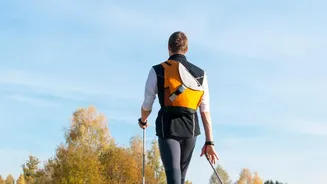
Herein lies the crux of the matter: without the correct technique, Nordic walking is just walking while carrying a pair of sticks. The benefits are unlocked through a specific motion. The poles are not meant to be planted in front for balance like hiking poles; instead, they are planted between your feet and used to actively push your body forward. This propulsive action is what engages the upper body and core muscles. Simply carrying the poles or planting them incorrectly negates much of the intended workout, turning a potential full-body exercise back into a lower-body one. Bad habits can also lead to diminished results or even strain on the wrong muscles and joints.
Common Mistakes and Simple Fixes
As more casual walkers adopt the activity, several common mistakes have emerged. One is choosing the wrong pole length. Poles that are too short cause you to hunch over, while poles that are too long can strain your shoulders. A general rule is to multiply your height in centimetres by 0.68 to find a good starting length. Another frequent error is maintaining a tense, clenched grip on the poles. The proper technique involves a 'plant, push, and release' motion, where you open your hand slightly at the end of the arm swing. Using bent elbows instead of a long, powerful arm swing from the shoulder is also a common mistake that reduces power and strains smaller joints. Finally, many beginners break the natural cross-body rhythm (opposite arm and leg forward) and fall into 'pacing'—moving the arm and leg on the same side together, which eliminates the crucial torso rotation that powers the movement.
Getting the Most from Your Walk
The transition of Nordic walking into a mainstream activity is a positive development for public health, offering an accessible, effective workout for millions. However, this shift underscores the need for greater awareness around correct form. The difference between simply walking with poles and performing true Nordic walking is significant. Without proper technique, you miss out on the enhanced calorie burn, upper-body conditioning, and core engagement that make the activity so beneficial. Investing a small amount of time to learn the correct arm swing, pole plant, and posture can transform an ordinary walk into an extraordinarily effective fitness routine, ensuring you reap all the rewards this Finnish-born workout has to offer.