

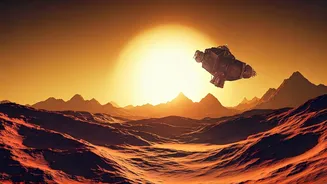




Meet Shukrayaan, India's Emissary to Venus
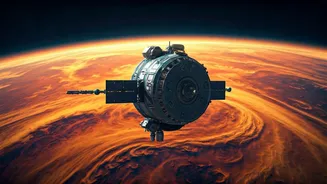
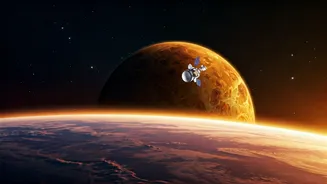
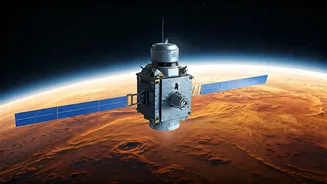
The Indian Space Research Organisation’s (ISRO) Venus Orbiter Mission, named Shukrayaan, is India's first dedicated mission to our 'twin' planet. Formally approved by the government in September 2024, the mission is slated for a March 2028 launch aboard
the powerful LVM3 rocket. After a journey of about four months, the 2,500 kg spacecraft will enter a highly elliptical orbit around Venus, eventually settling into a lower orbit to begin its scientific observations for a planned four years. The mission represents a major leap in India's interplanetary ambitions, following the successes of the Mars Orbiter Mission (Mangalyaan) and the Chandrayaan moon missions. It positions India within a select group of nations actively exploring Venus, with international partners from Russia, France, Sweden, and Germany contributing to the scientific payloads.
Venus: A Cautionary Tale of Climate Change
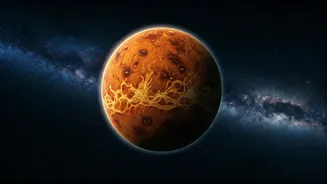
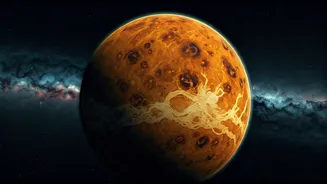
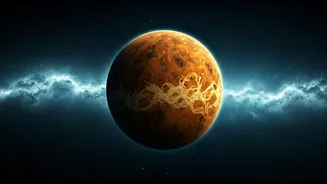
Venus is often called Earth’s twin due to its similar size, mass, and composition. Yet, the two planets could not be more different today. Venus suffers from a runaway greenhouse effect, with a crushing atmosphere that is 96% carbon dioxide and a surface temperature of over 460°C, hot enough to melt lead. Scientists believe Venus may have once been more Earth-like, possibly with liquid water oceans. However, less than a billion years ago, a dramatic climate shift occurred. It is thought that massive volcanic activity pumped enormous amounts of CO2 into the atmosphere, trapping heat, boiling away the oceans, and triggering the catastrophic greenhouse effect that defines the planet now. This makes Venus a perfect natural laboratory. By studying why our twin became so inhospitable, we can gain invaluable insights into the climatic tipping points that could affect Earth.
A Scientific Toolkit for a Hostile World
To peer beneath the thick, unbroken clouds of sulfuric acid, Shukrayaan will be equipped with a suite of sophisticated instruments. A key payload is a high-resolution Synthetic Aperture Radar (SAR), which can map the planet's surface in detail regardless of the dense cloud cover. This will help scientists look for signs of ongoing volcanic activity and understand its geological history. Shukrayaan will also be the first mission to use a ground-penetrating radar on Venus, allowing it to study the subsurface stratigraphy—the layers of rock beneath the surface—for the first time. Other instruments will study the complex atmospheric chemistry, the super-rotating winds that whip around the planet, and how the solar wind interacts with Venus's ionosphere in the absence of a global magnetic field.
From Venusian Skies to Indian Climate Models
The data collected by Shukrayaan is not just for academic curiosity; it has direct applications for climate science back home. Understanding the extreme greenhouse effect on Venus helps scientists refine the very models they use to predict climate change on Earth. By observing how a massive carbon dioxide atmosphere behaves under intense solar radiation, we can better understand the long-term consequences of rising CO2 levels in our own environment. Studying the dynamics of Venus's atmosphere—its cloud formations, weather patterns, and heat distribution—provides crucial data points that can make climate models for Earth more robust and accurate. This, in turn, can lead to better predictions of monsoon behaviour, heatwave intensity, and other critical weather phenomena impacting India.
A New Frontier for Indian Science
Shukrayaan is more than a single mission; it's a strategic investment in India's scientific future. By undertaking complex deep-space missions, ISRO fosters technological innovation, builds domestic expertise, and inspires a new generation of scientists and engineers. The mission's collaborative nature, involving multiple Indian research institutions and international space agencies, strengthens global scientific partnerships. The insights gained from Venus will not only help us protect our own planet but also inform the search for habitable exoplanets orbiting distant stars. By exploring the fate of our sister planet, India is helping to piece together the puzzle of how planets evolve and what it takes for life to thrive in the cosmos.