



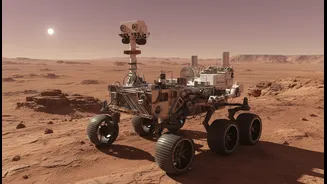


The Challenge of the Digital Leash
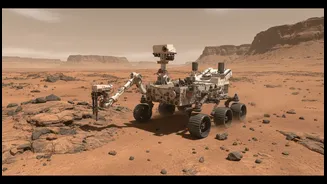
For all their advanced science, today's rovers are surprisingly dependent. Human operators on Earth painstakingly plan their every move, a process hampered by significant communication delays. A command sent to Mars can take many minutes to arrive, meaning
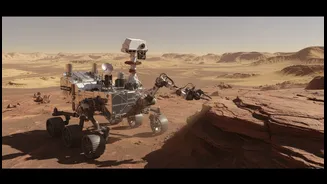
a rover can't react to unexpected obstacles or scientific opportunities in real-time. This cautious, step-by-step approach limits the ground they can cover and the discoveries they can make. Productivity is a major challenge; mission teams spend enormous effort planning daily activities, which are often based on incomplete data from orbit. The rovers must wait for instructions, execute them, and then beam the results back, creating a slow and deliberate operational cycle. This digital leash, while necessary for safety, prevents the kind of rapid, responsive exploration that could yield breakthrough science.
Teaching Robots to Think for Themselves
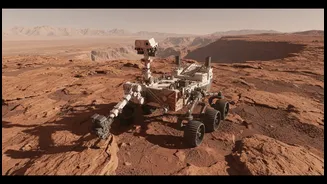
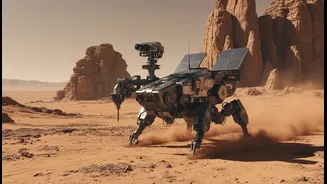
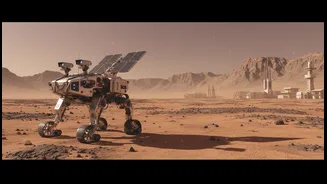
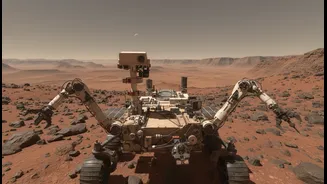
The key to unleashing rovers is advanced autonomy, powered by artificial intelligence (AI). Instead of waiting for commands, future rovers will be able to make their own decisions. NASA's Perseverance rover already uses a degree of autonomy called AutoNav to plot routes around obstacles. But new projects are taking this much further. NASA's Exploration Rover for Navigating Extreme Sloped Terrain (ERNEST) prototype uses AI and machine learning to assess its environment and choose the best path forward, even figuring out how to use its active suspension to climb over rubble that would trap older rovers. This technology, tested in the California desert, allows the rover to travel for miles with minimal human input. This leap in intelligence is achieved by running millions of simulations, essentially allowing the rover's AI to learn from months of virtual trial-and-error before it ever touches real soil.
Powering the Marathon Mission
Longer exploration requires a power source that doesn't depend on sunlight. While solar panels have been effective, they are useless during long Martian nights, in dust storms, or in the permanently shadowed craters of the Moon where water ice may be found. The solution is nuclear power. Both the Curiosity and Perseverance rovers use a Multi-Mission Radioisotope Thermoelectric Generator (MMRTG), which converts the heat from the natural decay of plutonium-238 into electricity. This provides a steady source of power and warmth for decades, independent of location or weather. Future concepts like NASA's PROMISE rover are designed around these power systems, enabling long-duration missions into the frigid, dark regions of the lunar South Pole to search for resources. Advanced fission surface power systems are also in development to provide even more energy for sustained operations on the Moon and Mars.
The Next Frontier of Discovery
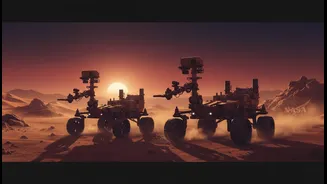
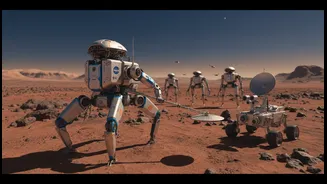
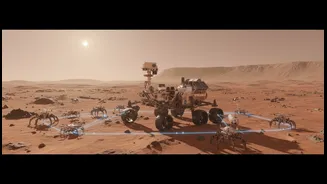
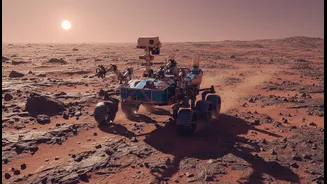
Combining independence with longevity transforms a rover from a remote-controlled tool into a true robotic field scientist. An autonomous, nuclear-powered rover could conduct a 'science road trip' across the Moon or Mars, covering vast distances and accessing previously unreachable areas like steep crater walls and lava tubes. This mobility is a boon for mission planners, who have long struggled to access high-interest geological sites. Furthermore, missions could involve teams of smaller, cooperative rovers that work together to map areas or gather data from multiple points simultaneously, a task impossible for a single machine. This could even enable in-situ resource utilization (ISRU), where rovers extract resources like water ice or minerals directly from the lunar or Martian soil to support future human missions. By making rovers more independent, we enable them to explore more efficiently, take more risks, and ultimately, return far greater scientific rewards.