





The Challenge of Predicting Our Planet
For decades, forecasting weather and modelling long-term climate has relied on complex physics-based simulations run on massive supercomputers. These traditional models are powerful but incredibly resource-intensive, requiring immense processing power and time
to generate predictions. The complexity of Earth's systems—from ocean currents to cloud formation—means that even the most advanced models struggle to provide the granular, hyper-local forecasts needed to effectively prepare for events like flash floods, intense heatwaves, or cyclones. This computational bottleneck has limited the speed and resolution at which scientists can work, leaving a gap between the data collected and the actionable insights communities need.
Enter Prithvi-Weather-Climate
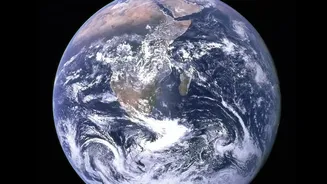
In partnership with IBM Research, NASA has developed a groundbreaking solution: an AI foundation model named Prithvi-weather-climate. Prithvi, the Sanskrit name for Earth, is designed to process vast amounts of climate data with unprecedented speed and efficiency. Unlike traditional systems, this AI is a foundation model, meaning it's trained on a massive, generalised dataset—in this case, 40 years of NASA's global climate data—and can then be fine-tuned for a wide range of specific tasks. This approach represents a fundamental shift from building separate models for every problem to creating one powerful, adaptable tool that can be used across the climate science community.
How AI Is Changing the Forecast
Instead of simulating the laws of physics from scratch, the Prithvi model learns patterns and relationships directly from historical data. Trained on four decades of observations from NASA's MERRA-2 dataset, it can identify complex atmospheric dynamics that traditional methods might miss. The result is a system that is not only faster but also more flexible. For example, it can take a small, localised sample of weather data and accurately reconstruct a global weather map by filling in the missing information. This ability to work with incomplete data and generate high-resolution outputs from lower-resolution inputs, a process known as downscaling, can be done at a fraction of the computational cost of conventional methods.
Faster Warnings and Better Preparation
The practical implications of this technology are enormous. More accurate and faster predictions of extreme weather events can directly save lives and protect infrastructure. For a country like India, which faces recurrent threats from cyclones, heatwaves, and erratic monsoons, the ability to generate better seasonal precipitation forecasts or more precise hurricane track predictions is invaluable. Early warnings allow communities and governments more time to prepare, manage resources, and mitigate risks. Beyond disaster management, this AI can help optimize renewable energy grids by providing better forecasts for wind and solar power generation, supporting the transition to cleaner energy sources.
A Tool for the Future, Not a Magic Bullet
While incredibly promising, the Prithvi AI model is designed to augment, not replace, existing climate models. Human expertise and physics-based simulations remain crucial for validating the AI's findings and pushing the boundaries of scientific understanding. The model's accuracy is dependent on the quality and quantity of the data it's trained on, and researchers are continuously working to refine it. NASA and IBM have made the model open-source, allowing scientists worldwide to download, use, and adapt it for their own research on platforms like Hugging Face. This collaborative approach aims to accelerate innovation and ensure the benefits of this powerful new tool are shared globally, helping us all better understand and respond to our changing planet.