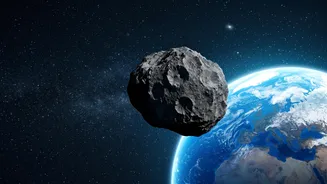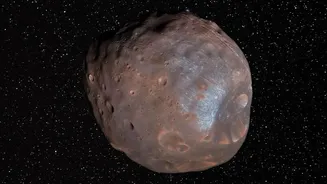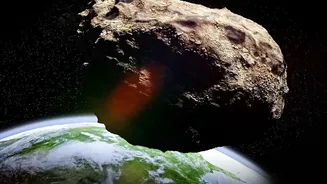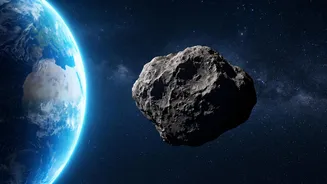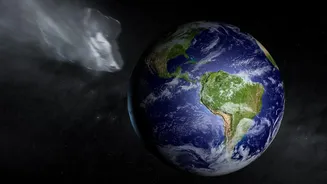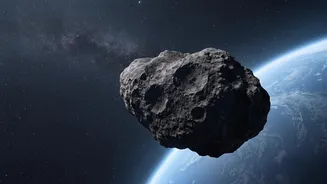


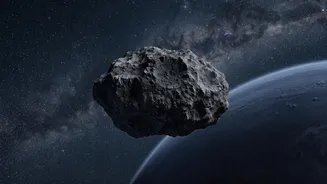
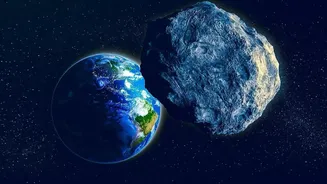
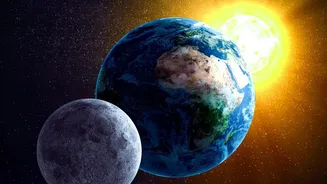
For a little while, Earth has a second moon. Astronomers have confirmed that a small asteroid, now named 2026 QQ8, has been temporarily captured by our planet's gravity. But this 'mini-moon' is just a fleeting visitor on a cosmic timescale.
What Exactly Is a Mini-Moon?
Unlike our
large, permanent Moon, a mini-moon is a small asteroid that gets pulled into a temporary orbit around Earth. These objects, formally known as Temporarily Captured Objects (TCOs), are typically just a few metres across. They come from the asteroid belt or are near-Earth asteroids whose paths bring them just close enough for our planet's gravity to snag them. Instead of continuing their own orbit around the sun, they begin to loop around Earth. This isn't the first time we've had a temporary companion; astronomers previously tracked 2006 RH120 and 2020 CD3, which also spent time as mini-moons before being flung back out into space.
The Delicate Dance of Capture
For an asteroid to become a mini-moon, a delicate balance of speed, trajectory, and timing is required. The asteroid must approach Earth at a relatively low velocity, allowing our planet's gravitational pull to overpower the Sun's. Think of it like a cosmic game of catch. If the asteroid is moving too fast, it will simply fly past, its path bent slightly by Earth's gravity in a 'fly-by'. If it's too slow or on a direct collision course, it could burn up in our atmosphere. Mini-moons like 2026 QQ8 thread the needle perfectly, entering what's known as the Hill sphere—the region of space where a planet's gravity is the dominant force for satellites. These captures often happen when the asteroid passes through specific gravitational equilibrium points, known as Lagrange points, which act as gateways into Earth's orbit.
Why the Visit Is So Short
The very factors that allow for a mini-moon's capture also ensure its departure. The orbits of these tiny worlds are highly unstable and chaotic. Unlike our large Moon, which is massive enough to have settled into a stable, long-term orbit, a small asteroid like 2026 QQ8 is at the mercy of a complex gravitational tug-of-war. The constant pulls from our own Moon and the much more powerful gravity of the Sun work to disrupt its fragile orbit. Every loop it makes around Earth is slightly different, and eventually, these gravitational perturbations will give the asteroid the nudge it needs to break free from Earth's grasp and continue its journey orbiting the Sun. Most mini-moons only stick around for a few months to a couple of years before being ejected.
A Valuable Scientific Opportunity
Even though their stays are brief, mini-moons are of huge interest to scientists. They are essentially free samples of asteroids delivered right to our doorstep. Studying their composition provides invaluable clues about the materials that formed our solar system. Because they are so close, they are ideal targets for potential future space missions. It would require far less fuel to visit a mini-moon and potentially collect samples than to travel to the main asteroid belt between Mars and Jupiter. These accessible targets allow us to test technologies for asteroid mining and, importantly, for planetary defense by helping us understand the physical properties of near-Earth objects.