




A Sweet Find Near the Galactic Center
In a landmark discovery, an international team of scientists has directly detected a sugar molecule called erythrulose floating in the interstellar medium. The finding was made by pointing powerful radio telescopes in Spain towards a massive, chemically
rich molecular cloud named G+0.693-0.027, located about 26,700 light-years away near the heart of the Milky Way. By analyzing the faint radio signals coming from this stellar nursery, researchers identified the unique spectral "fingerprint" of erythrulose, matching 12 distinct emission lines from the cloud to laboratory samples of the sugar. While sugars have been found in meteorites that have landed on Earth, this is the first time a true sugar has been unambiguously identified in the vast emptiness between stars, confirming that the ingredients for life can form long before planets do.
Why This Four-Carbon Sugar is Special
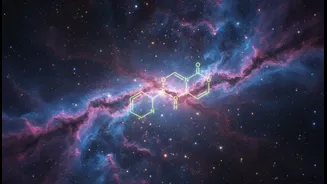
Erythrulose isn't just any sugar. On Earth, it’s a simple four-carbon sugar found in things like red raspberries. Its discovery in space is significant because sugars are fundamental to life as we know it, forming the backbone of RNA and DNA. Scientists have long hypothesized that before the complex five-carbon sugar ribose (used in RNA) became dominant, life may have relied on simpler structures. Erythrulose is a prime candidate for such a precursor. In the presence of water, it can easily convert into other four-carbon sugars that could have formed the basis of a more primitive genetic system, a potential evolutionary predecessor to RNA. Finding this specific molecule provides a tangible link between simple interstellar chemistry and the complex biochemistry that eventually led to life.
Rewriting the Cosmic Cookbook
Perhaps the most surprising part of the discovery is how much erythrulose was found. The cloud contains at least eight times more of this four-carbon sugar than its simpler, three-carbon cousins. This challenges the long-held assumption that complex molecules in space are built sequentially, by adding one carbon atom at a time. Instead, new models suggest that erythrulose forms more directly on the icy surfaces of cosmic dust grains. Two-carbon molecules, which are abundant in the region, likely combine to create the four-carbon sugar, bypassing the three-carbon stage entirely. This implies that the universe is more efficient at creating certain complex prebiotic molecules than previously thought, changing our understanding of the cosmic recipe for life.
From Interstellar Clouds to Early Earth
The discovery supports a tantalizing theory known as panspermia: the idea that life's essential ingredients may have been delivered to a young Earth from space. Scientists estimate that millions of tons of erythrulose could have arrived on our planet during the "Late Heavy Bombardment" period around 4 billion years ago, delivered by comets and meteorites that incorporated these interstellar materials. While the journey from a simple sugar to a living cell is immensely complex, having a ready supply of these key building blocks would have given prebiotic chemistry a powerful head start. It suggests the universe is seeded with the potential for life, with these stellar nurseries acting as giant chemical factories.