







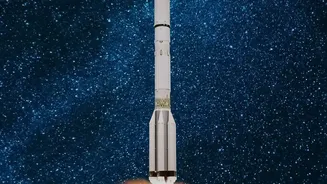
India’s New Space Age is Here
India is in the midst of a space revolution. Landmark missions like Chandrayaan-3's historic lunar south pole landing and the Aditya-L1 solar observatory have captured global attention and national pride. But the real story is the explosive growth of the entire
ecosystem. The government's 2020 reforms opened the doors to private enterprise, leading to a dramatic surge in innovation. Today, there are around 440 space startups in the country, up from just a handful a decade ago. This burgeoning private sector, combined with ambitious future projects like the Gaganyaan human spaceflight mission, a Venus orbiter, and the Bharatiya Antariksh Station planned for 2035, means India's space economy is projected to grow from around $8.4 billion to over $44 billion by 2033. This isn't just a government-led endeavour anymore; it's a full-fledged industry creating a vast new landscape of jobs.
Beyond the Astronaut Helmet
When students think of a career in space, the first image is often an astronaut. While Gaganyaan will indeed send Indian astronauts to orbit, the spectrum of careers is far broader and more accessible. The modern space industry needs a diverse range of experts. There is high demand for aerospace engineers to design rockets and satellites, and for satellite systems engineers to manage communication and navigation. But it doesn't stop there. The sector also needs software engineers and data scientists to analyse the vast amounts of information sent back from space, which can be applied to everything from climate monitoring and disaster management to agriculture. There are roles for robotics experts, propulsion specialists, and avionics engineers. Even non-technical fields are vital, with a growing need for professionals in space law, policy, and business management. The growth engine for the future will be these downstream applications that use space technology to solve real-world problems.
The Power of an Early Start
In this competitive and rapidly evolving field, starting early provides a significant advantage. Early exposure to space and STEM (Science, Technology, Engineering, and Mathematics) concepts does more than just teach facts; it cultivates a crucial mindset. It builds foundational skills in physics, maths, and coding in an engaging way. Learning about the challenges of space exploration—like designing a rocket or landing a rover—naturally teaches complex problem-solving, critical thinking, and resilience. When a child learns about orbital mechanics or builds a model rocket, they are not just playing; they are engaging in the same thought processes used by professional scientists and engineers. This early passion is a powerful motivator, encouraging students to stick with challenging STEM subjects through school and college, preparing them for the rigorous demands of a space-related career.
How to Cultivate Curiosity
Parents and educators can play a vital role in nurturing this interest. The Indian Space Research Organisation (ISRO) is actively fostering the next generation through outreach. Its YUVIKA (Young Scientist Programme) is a flagship initiative that gives school students hands-on experience and the chance to interact with senior scientists. Beyond formal programs, there are many accessible ways to spark curiosity. Encourage participation in science clubs and olympiads. Visit local planetariums and science museums. Follow ISRO's mission launches and updates online; many are now live-streamed and have become national events. Simple activities like stargazing, using online space exploration simulators, or building DIY satellite models can turn abstract concepts into tangible, exciting experiences. ISRO's various outreach activities, including workshops, exhibitions, and online courses, are designed specifically to engage students and make space science accessible.
From School Projects to Launch Pads
Connecting early interests to a formal career path is the final, crucial step. The curiosity sparked by a school project can be channelled by choosing the right subjects, focusing on a strong foundation in STEM disciplines. As students progress to higher education, they can look for specialised courses in aerospace engineering, astrophysics, or astronautical engineering. The rise of private companies like Skyroot Aerospace, AgniKul Cosmos, and Dhruva Space means there are now more internship and employment opportunities outside of government agencies. These companies are actively hiring for roles in launch vehicle development, satellite manufacturing, and data analytics. Building a strong academic record, participating in relevant projects, and actively seeking these opportunities can transform a childhood fascination into a thriving, high-impact career, contributing to India's journey as a global space leader.