



A Whisper From the Void
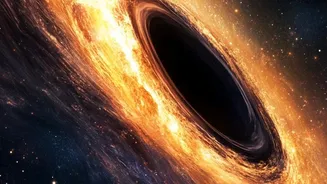
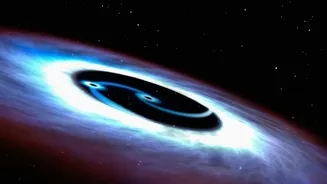
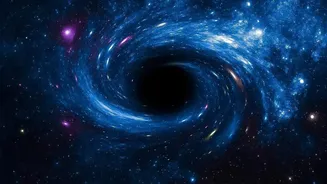
Imagine throwing two stones into a perfectly still pond. The ripples they create spread outwards, carrying information about the event. Now, imagine that pond is the fabric of spacetime itself, and the stones are two massive black holes smashing into each
other. The resulting ripples are gravitational waves. For the first time, scientists using a global network of detectors—the Laser Interferometer Gravitational-Wave Observatory (LIGO) in the United States, Virgo in Italy, and KAGRA in Japan—have captured the faint signal from such a specific and long-sought-after event: the merger of two intermediate-mass black holes (IMBHs). This isn't just another detection; it's the confirmation of a cosmic 'missing link' that scientists have theorized about for decades.
The Universe's Missing Middle Child
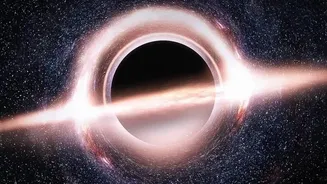
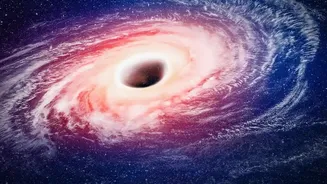
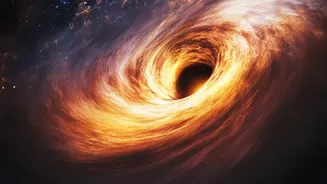
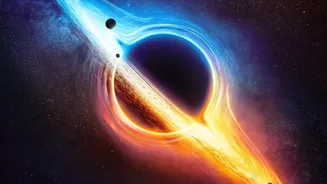
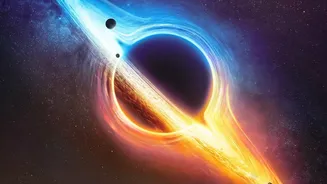
Astronomers have long been confident about two classes of black holes. There are the 'small' stellar-mass black holes, roughly 5 to 50 times the mass of our sun, which form when a single massive star collapses. Then there are the supermassive black holes, giants that are millions or even billions of times more massive than the sun, lurking at the heart of nearly every galaxy, including our own Milky Way. But what about the ones in between? This 'middle child' category, known as intermediate-mass black holes, has been notoriously difficult to find. They are too big to be formed from a single star but their origin has been a profound puzzle. This new detection provides the strongest evidence yet that they not only exist but are actively interacting in the cosmos.
Why This Collision Changes Everything
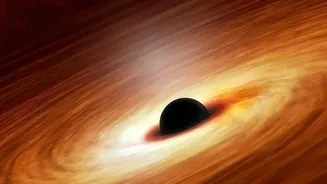
Finding these IMBHs is crucial because they are believed to be the building blocks of their supermassive cousins. One leading theory is that supermassive black holes grow over billions of years by swallowing stars, gas, and other black holes. A process called 'hierarchical merging' suggests smaller black holes merge to form larger ones, which then merge again, climbing the mass ladder. By observing two IMBHs in the act of merging, scientists are essentially witnessing a key step in this cosmic growth process. It provides a direct snapshot of how the universe might build its largest structures. This single event helps validate theories about galaxy formation and evolution, turning abstract ideas into observable reality.
A Symphony of Science and India's Role
Detecting these whispers from space requires some of the most sensitive instruments ever built. The LIGO, Virgo, and KAGRA observatories are L-shaped interferometers with arms several kilometres long. They use lasers to measure distortions in spacetime that are thousands of times smaller than the nucleus of an atom. This incredible feat is the result of a massive international collaboration involving over a thousand scientists. Soon, this global network will get even more powerful with the addition of LIGO-India. Construction has already begun on the observatory in Maharashtra, which is expected to be completed before its 2030 deadline. Once operational, LIGO-India will significantly improve the network's ability to pinpoint the location of these cosmic events, transforming India into a key player at the forefront of gravitational-wave astronomy.
Charting a New Cosmic Map
This discovery is more than just a single data point; it opens an entirely new chapter in astronomy. For centuries, we have studied the universe primarily through light. Gravitational waves offer a completely new sense, allowing us to perceive events that are otherwise invisible. With an ever-growing catalogue of detections, scientists are no longer just finding these events but are beginning to build a population study of black holes, analysing their masses, spins, and behaviours. The detection of merging IMBHs provides a vital new character in this cosmic drama, promising to solve long-standing mysteries and, undoubtedly, uncover new ones we haven't even thought to ask yet. We are truly at the dawn of a new era of cosmic exploration.