
The Grand Deception of the Horizon Moon
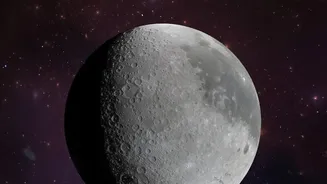
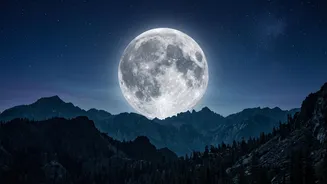
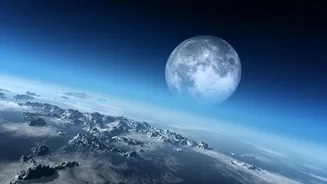
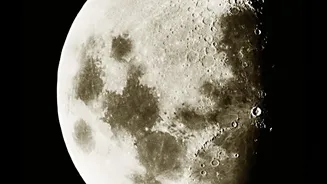
First, let's get one thing straight: the moon isn't actually changing size. Whether it's looming over a distant treeline or floating high in the zenith, its physical diameter and its distance from Earth remain virtually constant over a single night. Photographs
confirm this without a doubt. The enormous size you perceive when the moon is low in the sky is a powerful and ancient trick of the mind known as the Moon Illusion. People have been documenting this phenomenon for thousands of years, with early theories blaming the atmosphere for acting like a magnifying glass—an idea that has since been disproven. The real culprit isn't in the sky; it's between your ears.
Your Brain's Faulty Reference Check
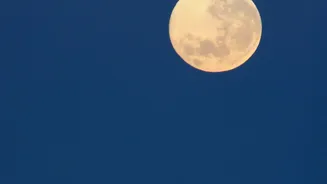
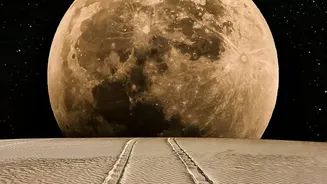
The leading explanation for this grand illusion is the 'Apparent Distance Hypothesis'. When the moon is on the horizon, your brain sees it in context with other objects whose sizes it understands: trees, buildings, and mountains. Because your brain knows those terrestrial objects are far away, it perceives the moon as being behind them, and therefore even farther away. Your brain's logic then kicks in: if an object is that far away and still takes up so much space in your field of view, it must be gigantic. So, it inflates the moon's perceived size. High in the sky, however, the moon floats in a vast emptiness. With no reference points, your brain defaults to seeing it as a lone, isolated object, and the illusion of immense size vanishes.
The Tube of Truth
This is where the paper tube comes in. By looking through a narrow tube, you are artificially removing all the contextual clues. You are isolating the moon from the trees, the horizon line, and all the other reference points that your brain was using for its faulty size calculation. All your eye sees is the moon surrounded by the black interior of the tube. Suddenly stripped of its environmental context, the moon appears to snap back to its 'normal'—or rather, its isolated—size. The tube doesn't change the moon; it changes what your brain is allowed to see with the moon. It effectively breaks the illusion by removing the very data that creates it.
A Trick Your Brain Plays on Itself
This isn't a one-off glitch. It's a fundamental part of how we perceive the world. A similar effect, known as the Ebbinghaus illusion, shows that a circle will appear larger when surrounded by smaller circles than when it's surrounded by larger ones. The horizon moon, framed by the comparatively smaller details of the landscape, is like the circle surrounded by smaller circles—it looks bigger. The zenith moon, surrounded by the vast, empty expanse of the sky, looks smaller by comparison. So, while the headline claims this 'defies physics assumptions', it actually confirms what neuroscientists know about perception: our brains construct our reality based on context, and sometimes, that context leads to some beautiful illusions.