







Looking for a unique way to decorate your walls without heavy frames or high costs? Origami offers a world of creative possibilities, allowing you to craft a stunning, lightweight, and deeply personal art arrangement with just paper and patience.
The Unique Charm of Paper Art
Forget
expensive canvases and heavy frames. The beauty of origami wall art lies in its simplicity and versatility. It’s an incredibly lightweight medium, making it perfect for renters or anyone who likes to frequently refresh their decor without worrying about damaging walls. The process itself is a meditative act, turning a simple sheet of paper into a three-dimensional object. When grouped, these individual creations form a cohesive art piece that can be as minimalist or as elaborate as you wish. From a flock of cranes soaring across a living room wall to a geometric cluster of pyramids above a desk, paper art adds texture, colour, and a handmade touch that is impossible to replicate with mass-produced decor.
Choosing the Right Paper
The foundation of your origami art is, of course, the paper. While you can practice with standard printer paper, investing in quality paper will elevate your final piece. 'Kami', the standard origami paper, is an excellent starting point for beginners; it's thin, easy to fold, and comes in a vast array of colours. For more durable or complex models, consider 'Tant' paper, which is stiffer and features a subtle texture. Paper weight, measured in GSM (grams per square meter), is also a factor. A weight between 80 GSM and 170 GSM is generally ideal, providing enough sturdiness to hold a shape without being too difficult to fold. Don't be afraid to experiment with different textures and finishes, such as washi paper for its traditional patterns or metallic paper for a reflective sheen.
Simple Folds, Stunning Displays
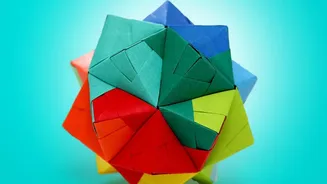
You don't need to be an origami master to create a beautiful display. In fact, some of the most effective arrangements are made from simple, repeated shapes. Classic models like the crane, butterfly, or simple flowers are perfect for beginners and look fantastic in large groups. Modular origami, where multiple identical units are interlocked to form a larger piece, is another great option. The Sonobe unit, for example, is a simple module that can be used to build striking 3D geometric shapes and pyramids. Focus on mastering one or two simple folds and then produce them in various sizes and complementary colours. The power of your final piece will come from the collection, not the complexity of a single fold.
Designing Your Arrangement
Before you begin attaching your creations to the wall, take some time to plan your layout. Lay your folded pieces on the floor to experiment with different configurations. You could create a structured grid for a modern, organised look, or a more organic, free-flowing cluster that mimics movement. Consider a gradient effect, arranging your pieces from light to dark or transitioning through a colour palette. Another approach is to create a single, large focal point from many smaller pieces, such as a heart or a circular mandala. Think about the space you’re decorating. A vertical arrangement can make a narrow wall feel taller, while a horizontal spread works well above a sofa or headboard. Sketching your idea on paper first can help you finalise the composition.
Mounting Your Lightweight Masterpiece
One of the greatest advantages of origami art is that it's incredibly light, which opens up a world of damagefree mounting options. For individual, flat pieces, removable poster putty or small pieces of washi tape can be both effective and decorative. For 3D models, doublesided adhesive strips offer a stronger hold without marking the walls. Another creative method involves threading your origami pieces onto string and hanging them from a small wooden dowel or branch to create a wall mobile. For a more robust display, you can glue your arrangement onto a piece of foam board or stiff cardboard, which can then be hung with a single removable hook. Some artists even use a system of small, strong magnets and thumbtacks to hold paper in place without piercing it.