





Light's Universal Speed Limit
We often think of light as instantaneous. Flip a switch, and a room is illuminated. But in the vast emptiness of space, light has a finite speed, and it's the fastest anything can travel in the universe. Light moves at a staggering 2,99,792 kilometres
per second. While that seems infinitely fast, the distances in space are so immense that even at this breakneck pace, light takes a significant amount of time to travel from one point to another. This delay is the key to understanding why stargazing is essentially a form of time travel. The light hitting your retina tonight did not begin its journey tonight; it has been travelling for years, decades, or even millennia.
Defining the Cosmic Yardstick
To measure these colossal distances, astronomers use a special unit: the light-year. This is a common point of confusion; a light-year is a measure of distance, not time. It is simply the distance that a beam of light travels in one Earth year. That distance is about 9.46 trillion kilometres. So, when we say a star is 10 light-years away, we mean that the light we see from it today started its cosmic voyage 10 years ago. The star itself might still be there, or it could have changed dramatically in the intervening decade, but we wouldn't know for another 10 years. We are always seeing a delayed broadcast from the universe.
Our Nearest Stellar Neighbours
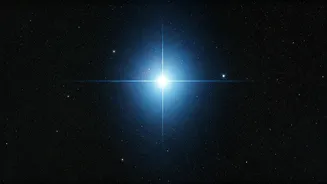
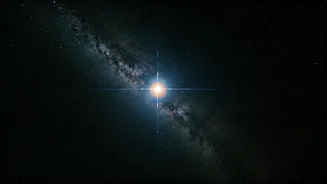
Let's bring this concept closer to home. One of the brightest stars in our night sky is Sirius, also known as the Dog Star. It is relatively close, at about 8.6 light-years away. This means the light from Sirius that you see tonight left the star around 2015. You are seeing the star not as it is now, but as it was when Virat Kohli was cementing his place as a cricketing legend. Another prominent star, Vega, in the constellation Lyra, is about 25 light-years away. Its light started travelling towards Earth around the late 1990s, a time when India was just beginning its IT boom.
Gazing into Bygone Eras
The headline's claim of 'centuries' becomes true when we look at more distant, but still easily visible, stars. Take Polaris, the North Star, a celestial landmark for navigators for centuries. It's approximately 433 light-years away. The light we see from Polaris today left the star around the year 1591. At that time, the Mughal Empire under Akbar was at its zenith, and Charminar in Hyderabad was newly constructed. When you look at Polaris, you are seeing light that is older than the Taj Mahal. Another example is the reddish giant star Betelgeuse in the Orion constellation, which is over 640 light-years away. Its light is a postcard from the 14th century, a time before the Lodhi dynasty ruled Delhi.
The Ultimate Cosmic Time Machine
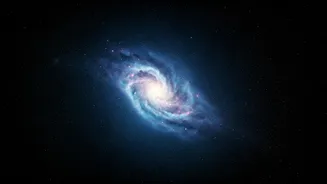
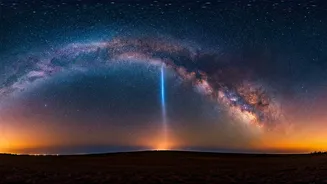
And we don't have to stop at stars within our own galaxy. On a clear, dark night, away from city lights, you might be able to spot a faint, fuzzy patch in the sky. This is the Andromeda Galaxy, our closest major galactic neighbour. That faint smudge of light is 2.5 million light-years away. The photons hitting your eye tonight from Andromeda began their journey when early human ancestors, like *Homo habilis*, were roaming Africa. You are not just looking at another galaxy; you are looking 2.5 million years into the past. This makes every telescope, and even our own eyes, the most powerful time machines ever built.