


A Growing Cosmic Cookbook
Imagine looking at a list of ingredients for a planet. You would expect to see rock, metal, and ice. But what if that list also included complex organic molecules? Recently, astronomers using powerful radio telescopes have been adding to this cosmic cookbook.
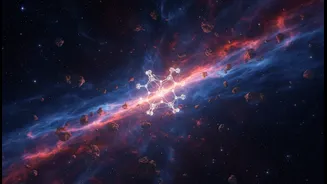
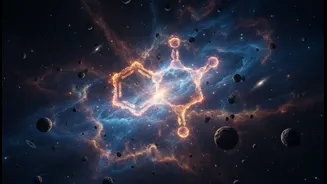
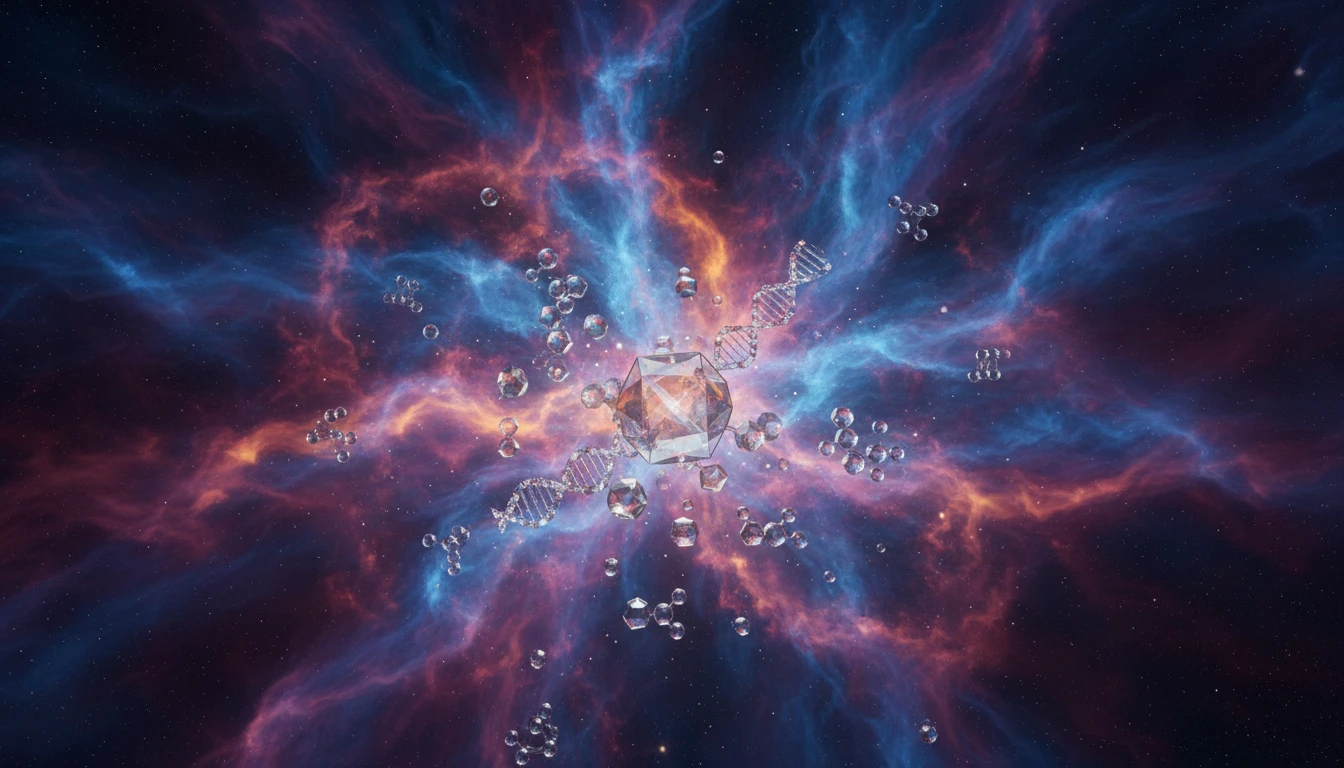
An international team of scientists recently detected 2-methoxyethanol, a 13-atom molecule, in a star-forming region known as NGC 6334I. This is one of the largest and most complex molecules of its kind ever found in interstellar space. Such discoveries are not isolated incidents. In other stellar nurseries, researchers have identified molecules like glycolonitrile, a key precursor to one of the nucleobases that forms DNA, and even simple sugars. These findings prove that the universe is a far more chemically interesting place than we once imagined, capable of building surprisingly intricate structures long before planets even exist.
The Stellar Nursery as a Factory
These discoveries are being made in stellar nurseries—enormous, cold, and dense clouds of gas and dust that are slowly collapsing under their own gravity to form protostars. Think of them as cosmic factories. In the cold, dark depths of these clouds, simple atoms and molecules stick to the surfaces of dust grains, where they can interact and combine to form more complex compounds. As a protostar ignites at the centre of the cloud, it warms up its immediate surroundings, creating a “hot corino” or cocoon. This warmth causes the complex molecules frozen onto the dust grains to sublimate, turning them back into gas. It is in this gas phase that astronomers can detect their faint signals from across the galaxy. These regions, such as the well-studied protostar system IRAS 16293-2422, are windows into the conditions that were present when our own solar system was just beginning to form over 4.5 billion years ago.
Identifying Molecular Fingerprints
Detecting a specific molecule from thousands of light-years away is an incredible feat of scientific detective work. It’s not as simple as just pointing a telescope and seeing the molecule. Instead, astronomers rely on a technique called rotational spectroscopy. As molecules tumble and spin in space, they emit or absorb radio waves at very specific frequencies. This pattern of frequencies acts like a unique spectral “barcode” or fingerprint for each molecule. The challenge is that to find a molecule in space, you first need to know what its barcode looks like. This forces a close collaboration between astronomers and laboratory chemists, who must first measure the molecule’s precise spectrum on Earth. Only with that reference data in hand can astronomers sift through the torrent of signals collected by telescopes like the Atacama Large Millimeter/submillimeter Array (ALMA) in Chile to find a definitive match.
From Interstellar Gas to New Worlds
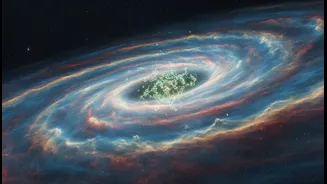
So, how do these molecules floating in a gas cloud become part of a solid planet like Earth? The process is a story of cosmic aggregation. The dust grains in the disc of material swirling around a young star are coated with these complex molecules in the form of ice. These icy dust grains begin to stick together, forming pebbles, then larger rocks, and eventually the cores of comets, asteroids, and planets. This means that the chemical building blocks of a new world are not necessarily created on that world itself but are delivered ready-made from the interstellar cloud that birthed the star. Comets and asteroids, which are essentially leftover construction material from this process, can then deliver these ingredients—including water and organic compounds—to young, rocky planets through collisions, potentially kick-starting prebiotic chemistry.
The Search for Our Origins
Each new molecular discovery helps to fill in the story of our own origins. Finding complex organic compounds, some of which are direct precursors to the building blocks of life like amino acids and nucleobases, in the material from which stars and planets are born is profoundly significant. It suggests that the raw materials needed for life are not a rare fluke but are naturally synthesized across the galaxy. This doesn’t mean that life is common, but it does imply that the chemical potential for life is widespread. The detection of these molecules in environments similar to our early solar system strengthens the theory that the ingredients for life on Earth were delivered from space. It transforms our understanding of planetary formation from a purely geological process to a rich astrochemical one.