







A Fireball Over the Ocean
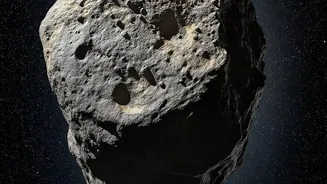
The small space rock, officially designated 2026 RW1, was first detected by the Mount Lemmon Survey in Arizona. It was only about one meter in diameter—roughly the size of a washing machine. Almost immediately, orbital calculations confirmed it was on a direct
course with Earth. Within hours, a global network of astronomers and automated systems had refined its trajectory, predicting it would enter the atmosphere over the ocean near the northwestern coast of Australia. Because of its tiny size and remote impact location, the asteroid posed no threat. It entered the atmosphere exactly as predicted, creating a bright fireball that burned up completely before anything could reach the ground. For scientists, it was a perfect real-world drill, and the 13th time an incoming asteroid had been successfully spotted before impact.
The Global Neighbourhood Watch
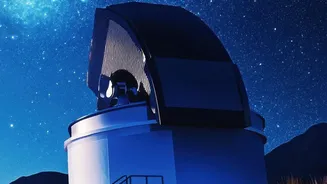
Detecting an object like 2026 RW1 is the job of a sophisticated global network dedicated to planetary defense. Leading the effort is NASA's Planetary Defense Coordination Office (PDCO), established in 2016 to find, track, and characterize near-Earth objects (NEOs). The PDCO works with international partners like the European Space Agency (ESA) and coordinates a web of ground-based observatories. Surveys such as the Catalina Sky Survey in Arizona, which discovered 2026 RW1, and the Asteroid Terrestrial-impact Last Alert System (ATLAS) in Hawaii, Chile, and South Africa, are the planet's front line. These surveys automatically scan the sky every clear night, taking pictures of the same patch of sky minutes apart. By comparing these images, computer algorithms can spot the faint specks of light that move against the fixed background of stars.
From Discovery to Alert
Once a potential NEO is flagged, the information is sent to the Minor Planet Center (MPC), the global clearinghouse for all asteroid and comet observations. The MPC collects data from observatories worldwide to verify the object and calculate a preliminary orbit. From there, automated systems like NASA's Sentry and ESA's Meerkat take over. These programs perform complex calculations to determine the asteroid's future path, assessing its probability of hitting Earth for the next 100 years. For an imminent impactor like 2026 RW1, this process happens in a matter of hours. As more observations pour in, the trajectory is refined, narrowing down the potential impact zone from a wide area to a specific location and time. This rapid analysis is what allows authorities to issue timely and accurate warnings.
Why We See Them So Late
Discovering an asteroid only hours before it arrives might sound alarming, but for small objects, it is a sign of success. The primary goal of planetary defense is to find the big ones—asteroids larger than 140 meters, which could cause regional devastation. These are large enough to be detected years or even decades in advance, giving humanity time to react. By contrast, meter-sized rocks like 2026 RW1 are incredibly faint and numerous. They can only be seen when they get very close to Earth. The fact that our systems are now capable of spotting these tiny, fast-moving objects at all is a significant advancement. NASA estimates that objects smaller than 25 meters will almost always burn up in the atmosphere, posing little to no danger. So, while a few hours' notice is short, for these small visitors, it’s all we need.
The Future of Planetary Defense
While the current network is effective, scientists are not standing still. The next generation of survey telescopes, like the Vera C. Rubin Observatory in Chile, will scan the sky even more deeply and rapidly, cataloging millions more asteroids. Beyond simply watching, NASA is also testing active defense strategies. The Double Asteroid Redirection Test (DART) mission in 2022 successfully demonstrated that a spacecraft could intentionally collide with an asteroid to alter its course. This historic test proved that, with enough warning time, we have the technology to deflect a hazardous object. It shifted planetary defense from a theoretical exercise to a proven capability, ensuring that if a larger threat is ever found, we have a plan to protect ourselves.