





The Tyranny of Distance
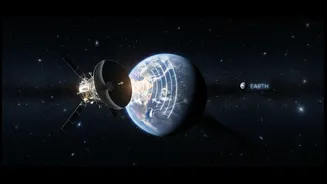
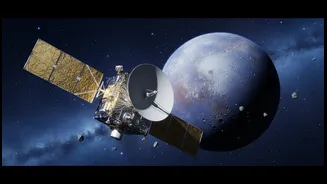
As of mid-2026, the New Horizons spacecraft is roughly 9.5 billion kilometres from Earth, venturing through a distant, icy region called the Kuiper Belt. That number is so large it's almost meaningless. So, think of it this way: if you could drive a car
at a constant 100 km/h, it would take you over 10,000 years to cover that distance. Light, the fastest thing in the universe, still takes an incredible amount of time to cross this void. A radio signal sent from Earth to New Horizons travels for about 8 hours and 52 minutes to arrive. Because the spacecraft can't respond until it gets the message, that means any reply will take another 8 hours and 52 minutes to get back. This gives a round-trip communication time of nearly 18 hours.
Your Turn at Mission Control
You can simulate this staggering delay with a simple thought experiment. Find a friend and go to separate rooms where you can't hear each other. You're Mission Control, and your friend is the New Horizons spacecraft. Agree that for every question you text them, they must wait five full minutes before they even begin to type a reply. Then, they send their answer. The frustration and deliberate slowness you'll feel during this 'game' is a tiny taste of the daily reality for the engineers at the Johns Hopkins Applied Physics Laboratory who guide the probe. Every command is a commitment, and every confirmation is a long-awaited echo from the darkness.
The 'Command Sequence' Solution
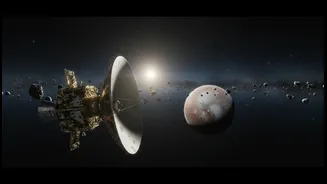
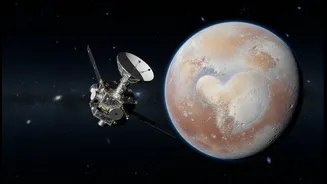
So, if you can't joystick the spacecraft in real-time, how do you operate it? The answer is meticulous, long-term planning. Mission planners don't send one instruction at a time; they bundle hundreds or thousands of commands into a single, massive upload called a command sequence. This sequence contains a script of everything the spacecraft is supposed to do over a period of days or even weeks: when to turn, which instruments to power on, what to observe, and when to phone home with the results. The spacecraft then executes this complex plan autonomously. This is how New Horizons could perform its flawless, high-speed flyby of Pluto in 2015 without any live input from Earth. The entire encounter sequence was loaded onto its computers well in advance.
A Patient Explorer at the Frontier
This method of operation is what allows New Horizons to continue its groundbreaking work. After waking from a nearly year-long hibernation in June 2026, the probe is now sending back data it collected on the environment in the Kuiper Belt. Soon, it will begin new observations, studying the vast bubble around our sun called the heliosphere. The data trickles back at a slow pace, around 1 to 2 kilobits per second, but it's rewriting our understanding of the solar system's edge. The probe has survived budget debates and technical anomalies, all while being operated by a team that has mastered the art of the long-distance relationship.