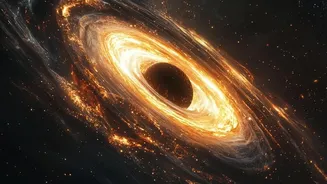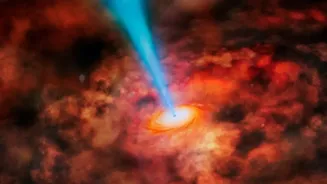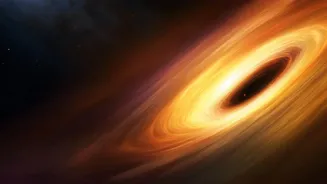



The universe is filled with mysteries, but few are as profound as dark matter. Now, a mind-bending theory suggests a link between this invisible substance and a new, hypothetical class of black holes of almost unimaginable size and power.
Beyond Supermassive: A New Cosmic Weight Class
Astronomers are
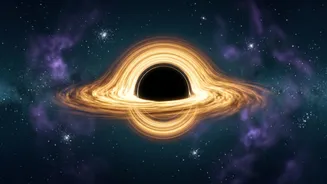
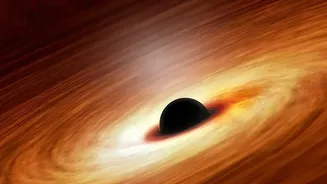
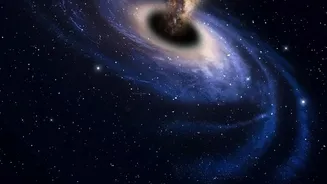
already familiar with supermassive black holes (SMBHs), the giants that lurk at the centre of most large galaxies, including our own Milky Way. These behemoths can weigh millions or even billions of times the mass of our Sun. But now, some physicists are contemplating an even grander scale: 'stupendously large black holes', or SLABs. This theoretical category describes black holes with a mass starting at 100 billion times that of the Sun. To put that into perspective, the largest confirmed black hole, TON 618, is estimated to be around 66 billion solar masses. A SLAB would not just be larger; it could be more massive than its entire host galaxy, stretching across a space larger than our solar system.
The Primordial Connection to Dark Matter
So where would such a monster come from? The leading theory is that SLABs would not form like typical black holes, which are the collapsed remnants of massive stars. Instead, they would be 'primordial'. This means they would have formed in the chaotic, dense conditions of the very early universe, just moments after the Big Bang, from the direct collapse of massive fluctuations in matter. This origin story is crucial because it untethers them from the size limits of collapsing stars and allows for a vast range of masses. More importantly, it connects them to the puzzle of dark matter. For decades, scientists have theorized that primordial black holes (PBHs) of various sizes could be the elusive dark matter that makes up about 85% of the universe's matter but doesn't interact with light. While SLABs themselves are likely too large and too rare to be the sole explanation for dark matter, their existence would provide strong evidence for the primordial model, suggesting smaller, more numerous PBHs could be the answer.
An Elegant but Unproven Theory
It's important to stress that SLABs are, for now, entirely hypothetical. No black hole approaching this scale has ever been directly observed. However, their potential existence isn't just a wild guess; it's a theoretical solution to some of cosmology's biggest questions. The challenge is figuring out how to prove they are real. Scientists can search for them indirectly by looking for their gravitational effects. A SLAB's immense gravity would warp spacetime so much that it would bend the light from distant objects behind it, an effect called gravitational lensing. Looking for these specific lensing signatures in large surveys of the sky is one of the primary methods proposed for hunting these invisible giants.
A Grainy Universe? What the Latest Research Says
Recently, the SLAB-as-dark_matter hypothesis was put to a significant test. Researchers reasoned that if a large fraction of dark matter was composed of these stupendously massive objects, the universe would be 'grainy' on a cosmic scale, rather than having dark matter distributed like a fine dust. This graininess would have left a faint but detectable imprint on the Cosmic Microwave Background (CMB) — the leftover light from the Big Bang. A study published in late 2026 analysed this ancient light and found no such graininess. The conclusion was that SLABs cannot be a major component of dark matter. However, this doesn't rule out their existence entirely. It simply means that if they are out there, they are likely very rare and not the primary solution to the dark matter mystery. The search for smaller, asteroid-mass primordial black holes as a dark matter candidate continues.