



What Exactly Are These Cosmic Clouds?
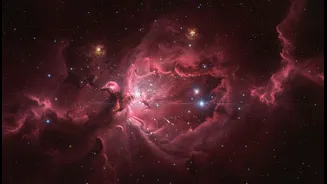
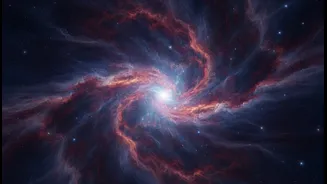
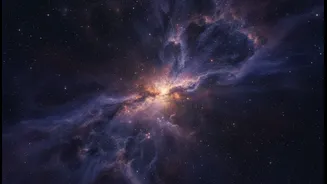
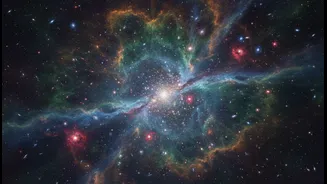
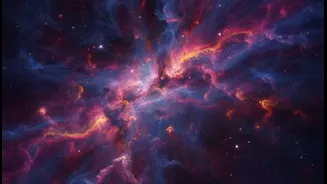
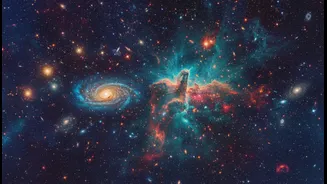
A nebula, Latin for 'cloud', is a vast expanse of gas and dust floating in the space between stars. These clouds are composed primarily of hydrogen and helium, the most abundant elements in the universe, along with tiny dust particles. They can span hundreds
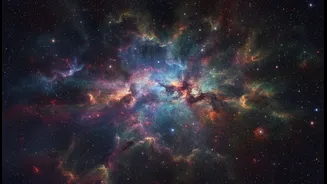
of light-years in diameter, with sizes so immense they are difficult to comprehend. Nebulae aren't all the same; they come in several varieties. Some are dark, dense clouds that block out the light from stars behind them, appearing as dark patches in the sky. Others, known as bright nebulae, glow with their own light or reflect the light of nearby stars, creating the spectacular colours we see in images from telescopes like Hubble and the James Webb Space Telescope.
The Stellar Nurseries of the Universe
The most vital role of many nebulae is that of a “stellar nursery,” the place where new stars are born. The process begins with gravity. Within these massive clouds, the dust and gas are spread out, but gravity slowly pulls particles together into clumps. As a clump gathers more material, its gravitational pull increases, attracting even more gas and dust. Over millions of years, this process accelerates, causing the clump to collapse under its own weight. The centre of this collapsing core becomes incredibly dense and hot, forming a protostar. When the core reaches a temperature of millions of degrees, nuclear fusion ignites. In this moment, hydrogen atoms begin to fuse into helium, releasing an enormous amount of energy. A star is born, shining for the first time.
Forging the Building Blocks of Planets
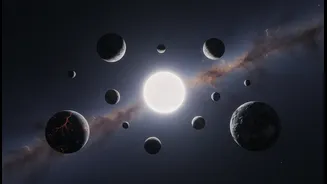
The birth of a star is the main event, but what happens to all the leftover material? As the protostar formed, the collapsing cloud flattened into a spinning disc, much like a pizza chef flattens dough by spinning it. This is called a protoplanetary disk, and it continues to orbit the newborn star. Within this disc, the leftover gas and dust particles begin to stick together. Through a process called accretion, these small particles form larger and larger objects—first pebbles, then rocks, then boulders, and eventually planetesimals, the building blocks of planets. Closer to the hot, new star, rocky materials like silicates and metals condense to form terrestrial planets like Earth and Mars. Farther out, where it's colder, ice and gas can also accumulate, forming gas giants like Jupiter and Saturn.
A Window Into Our Own Past
This process, known as the nebular hypothesis, is the most widely accepted explanation for how our own solar system formed about 4.6 billion years ago. Our Sun, Earth, and all the other planets were born from a giant, rotating cloud of gas and dust called the solar nebula. By studying nebulae and young, developing star systems across the galaxy, astronomers are essentially looking back in time. Telescopes like the James Webb Space Telescope can peer through the dust with their infrared vision, giving us an unprecedented look at stars in the process of forming and the protoplanetary disks surrounding them. Each observation provides a snapshot that helps us refine the story of how our own planetary home came to be.
The Cosmic Recycling Programme
Nebulae are not just about beginnings; they are also about endings and renewal. Some types of nebulae, like planetary nebulae and supernova remnants, are formed from dying stars. When a star like our Sun reaches the end of its life, it will gently shed its outer layers, creating a beautiful, glowing shell of gas called a planetary nebula. Massive stars end their lives more dramatically in a powerful explosion called a supernova. These events blast the heavier elements forged inside the star—like carbon, oxygen, and iron, which are essential for life—out into space. This enriched material mixes with existing interstellar clouds, seeding the next generation of nebulae. From these recycled materials, new stars and planets will form, continuing the grand cosmic cycle of birth, death, and rebirth.